
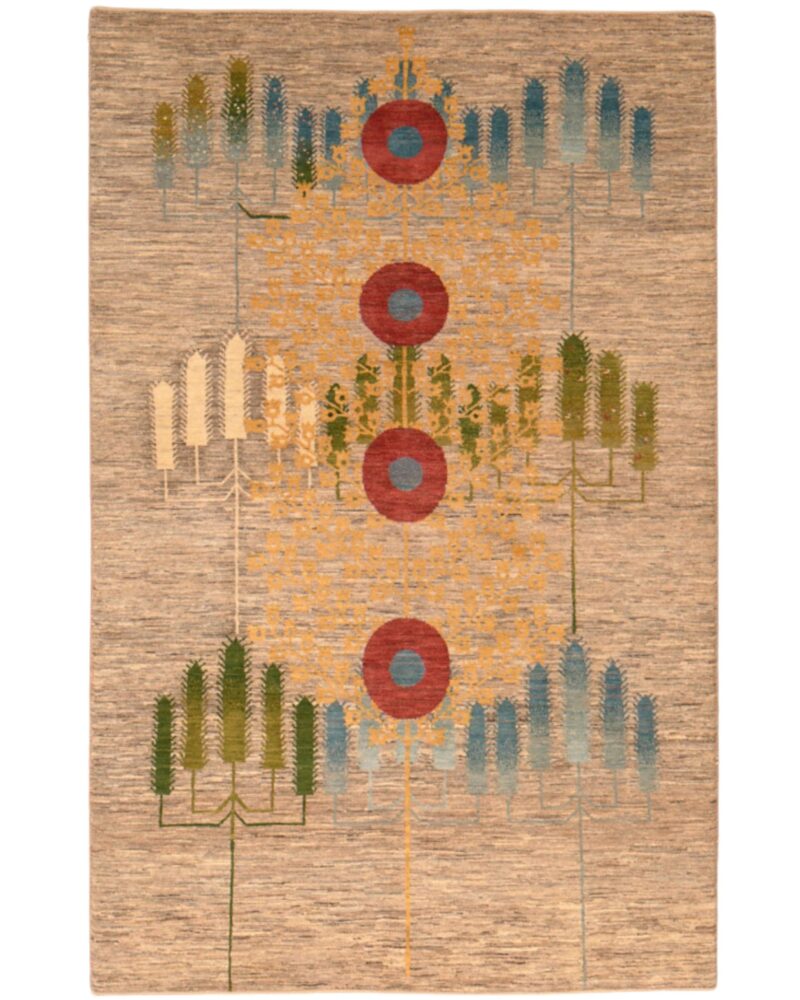

Gabbeh rugs come out of the nomadic weaving camps of the Qashqai and Luri tribes in the Zagros Mountains of southwestern Iran, and they carry that heritage in every knot. Unlike the dense, formal city rugs of Tabriz or Isfahan, Gabbeh pieces are loose, chunky, and deliberately imperfect, woven by shepherding families who used what was on hand: hand-spun wool from their own flocks, dyed with walnut husk, pomegranate rind, and indigo. Shoppers gravitate toward this collection when they want warmth and texture underfoot without the visual busyness of a traditional medallion rug, and when they value a piece with real tribal provenance rather than a commercial reproduction.
What Defines Gabbeh Rugs
Construction-wise, Gabbeh rugs are hand-knotted on horizontal ground looms, often set up right in the weaver’s tent or yard rather than a fixed workshop. Knot density typically runs 25 to 60 knots per square inch, far looser than the 150-plus counts you’d see in a fine Persian city rug, and that open structure is exactly what gives Gabbeh its soft, pillowy hand. Pile height generally sits between 0.5 and 0.75 inches, noticeably taller and shaggier than the close-cropped pile of a Heriz or Kashan. The weave itself is asymmetrical (Persian) knotting on a wool foundation, with the weft left loose between rows so the finished rug has a slightly irregular, hand-built texture rather than a perfectly flat surface.
Materials are almost always 100% hand-spun, hand-carded wool, sourced from local sheep herds, which gives the rug noticeable weight, often 50 to 70 ounces per square yard depending on pile density. You’ll occasionally find Gabbeh pieces with a wool pile on a cotton warp for added stability in larger formats, and higher-end contemporary Gabbeh from Iranian ateliers sometimes incorporates a small percentage of silk highlighting in the field for subtle sheen. Color palettes lean toward warm, saturated solids: rust, amber, chartreuse, deep plum, and camel, built from natural dyes like madder root, pomegranate, and walnut shell. Motifs are minimal and abstract by design, think scattered animal figures, simple diamond lattices, or a single open field, reflecting the improvisational, almost folk-art approach of the weavers rather than a pattern book.
Key Features to Look For
When you’re evaluating a Gabbeh rug for purchase, a few specifics separate a well-made piece from a thin, mass-produced copy.
- Hand-spun wool pile with visible slub and texture variation, not the uniform, machine-carded wool used in commercial knockoffs
- Knot count in the 25-60 KPSI range with a pile height of 0.5 to 0.75 inches, giving the rug its signature soft, cushioned feel
- Vegetable or natural dye base, which produces slight color abrash (tonal shift) across the field rather than one flat, uniform shade
- Available in sizes from small 2×3 accent pieces up through 9×12 and larger room-size formats, since tribal looms can produce both scatter rugs and large-format weaves
- Price positioning generally mid-range compared to fine Persian city rugs, reflecting the simpler loose weave, though exceptional vintage or silk-highlight pieces command a premium
- Moderate care requirements: the dense wool resists soiling well day to day, but the looser knot structure means it needs gentler handling during deep cleaning than a tightly woven rug
Styling Gabbeh Rugs in Your Home
These rugs do their best work in casual, lived-in spaces, family rooms, bedrooms, reading nooks, where you want something soft to walk on barefoot and don’t need a formal medallion anchoring the room. A solid-toned Gabbeh in rust or camel pairs naturally with mid-century furniture, Scandinavian-style oak pieces, or a modern neutral sofa, since the rug supplies the color and texture while the furniture stays simple. In a bohemian or organic-modern interior, layer a smaller Gabbeh over a larger jute or flatweave rug for depth without overwhelming the room with pattern.
Because the color fields are so open, Gabbeh rugs also work well as a grounding piece in rooms with busy art or patterned textiles elsewhere, think a gallery wall or patterned throw pillows, since the rug itself won’t compete for attention. For bedrooms, a 5×8 or 6×9 Gabbeh placed so it extends 18 to 24 inches beyond the sides of the bed gives you that plush wool underfoot on both sides. If you’re mixing eras or styles in one room, a single strong Gabbeh color, like chartreuse or deep plum, can act as the unifying thread that ties an otherwise eclectic furniture mix together.
Frequently Asked Questions
What size Gabbeh rug should I buy for a living room?
For most living rooms, an 8×10 or 9×12 works best, large enough that at least the front legs of your sofa and chairs sit on the rug. Smaller 5×7 or 6×9 sizes suit a seating area centered on a coffee table in a tighter space. Measure your furniture footprint first and leave 12 to 18 inches of bare floor around the perimeter as a general guideline.
How do I clean and maintain a Gabbeh rug?
Vacuum regularly on a low-suction or no-beater-bar setting since the looser knot structure can loosen under aggressive brush action, and rotate the rug every 6 to 12 months to even out sun fading and foot traffic wear. Blot spills immediately rather than rubbing, which can distort the loose pile. For anything beyond light surface dirt, a professional rug cleaning service that understands hand-spun wool and natural dyes is worth the investment, since home cleaning products or harsh agitation can bleed the vegetable dyes.
Are Gabbeh rugs durable enough for high-traffic areas?
Gabbeh wool is dense and naturally resilient to crushing, so the rugs hold up well in moderate-traffic spaces like bedrooms, home offices, and family rooms. The looser weave, however, makes them less ideal than a tightly knotted rug for true high-traffic zones like entryways or main hallways, where repeated heavy foot traffic can gradually loosen knots over years. If a knot does pull loose or the fringe frays, a rug repair and restoration specialist can reknot the area before the damage spreads.
Is every Gabbeh rug handmade, and how can I tell?
Authentic Gabbeh rugs are hand-knotted by tribal or village weavers in Iran, primarily in the Fars province region, and genuine pieces show slight irregularities in knot spacing, pattern placement, and color abrash that machine-made versions can’t replicate. Check the back of the rug: hand-knotted pieces show individual knots and slight pattern bleed-through, while machine-made rugs have a uniform, mesh-like backing. If you’re buying a significant piece and want written confirmation of origin and construction, a formal rug appraisal will document that for insurance or resale purposes.