
-
Fine Moroccan Design 7.8 x 3
Original price was: $2,200.00.$1,100.00Current price is: $1,100.00. -
Fine Moroccan Design 8.1 x 2.9
Original price was: $1,750.00.$875.00Current price is: $875.00. -
Fine Moroccan Design 8 x 2.9
Original price was: $1,750.00.$875.00Current price is: $875.00.
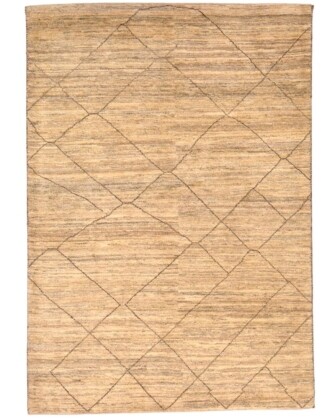


Moroccan rugs trace back to the Berber tribes of the Atlas Mountains, where weaving has been passed down through generations as a practical craft tied to shelter and survival rather than decoration alone. Tribes like the Beni Ourain, Boujad, and Azilal each developed their own patterns and knotting habits, often distinguishable by eye once you’ve handled enough of them. Shoppers gravitate toward this collection for the thick, forgiving pile underfoot and the loose, asymmetrical geometry that reads as intentional even when it’s clearly hand-drawn rather than templated. These rugs work because they’re imperfect in a way that feels earned.
What Defines Moroccan Rugs
Most pieces in this category are hand-knotted on vertical looms using a Berber knotting technique that produces a looser weave than you’d find in a Persian or Turkish rug — typically 25 to 50 knots per square inch, compared to 100-plus in finer Oriental weaves. That lower knot density is precisely what gives Moroccan rugs their plush, high pile, often running 0.75 to 1.5 inches, sometimes deeper in older Beni Ourain pieces. Weight tends to land between 3 and 5 pounds per square yard depending on wool quality and pile height, and the foundation is usually hand-spun wool on a wool or cotton warp, giving the rug some give and bounce rather than the flat rigidity of a kilim.
Wool remains the dominant material, often undyed and left in its natural cream, ivory, or taupe state, though Boujad and Azilal variations introduce hand-dyed wool in rust, saffron, magenta, and indigo using traditional plant and mineral dyes. Cotton sometimes reinforces the foundation for added structural stability, and you’ll occasionally find wool-silk blends in newer commercial interpretations aimed at a softer sheen. Motifs lean abstract and tribal — diamond lattices, zigzag lines, asymmetrical dashes, and symbolic marks tied to Berber lineage or protection — laid out with a freehand irregularity that separates genuine tribal work from the more rigid, mirror-symmetric medallions typical of Persian design.
Key Features to Look For
Not every rug labeled “Moroccan” is built the same way, so it helps to know what separates a well-made piece from a thin imitation.
- Hand-knotted wool construction with a visible, irregular knot pattern on the back — a telltale sign of genuine tribal work rather than a power-loomed copy
- Pile height between 0.75 and 1.5 inches for authentic Beni Ourain and Azilal styles, offering real cushioning underfoot
- Natural, undyed wool tones for minimalist pieces, or hand-dyed wool in saturated colors for Boujad-style statement rugs
- Sizes ranging from small 3×5 accent pieces to oversized 9×12 and 10×14 formats, though vintage tribal rugs often run in irregular, non-standard dimensions
- Price positioning from a few hundred dollars for smaller machine-assisted pieces to several thousand for large, vintage, hand-knotted originals
- Moderate to high care requirements — the deep pile traps dirt and sheds more in the first few months than a flat-weave rug, so routine maintenance matters
Styling Moroccan Rugs in Your Home
These rugs sit comfortably in living rooms, bedrooms, and reading nooks where bare feet and lounging are the point — the thick wool pile is built for direct contact, not just visual effect. In a mid-century or Scandinavian-leaning space, a natural undyed Beni Ourain grounds the room without competing with cleaner furniture lines, while a bold Boujad piece with rust and magenta tones works as the focal point in a bohemian or eclectic room where the furniture stays neutral. Layering a smaller vintage Moroccan piece over a jute or sisal rug also adds texture without overwhelming a space that needs both softness and structure.
Color pairing is fairly forgiving given how muted most traditional dye palettes are — cream and taupe pieces pair with walnut, oak, or black metal furniture, while the hand-dyed Boujad and Azilal styles hold their own against leather, rattan, and brass accents. In a bedroom, a Moroccan rug placed at the foot of the bed or spanning three-quarters of the floor space under the bed frame gives the plush pile room to be felt first thing in the morning. Because the pile holds dust and fiber more than flatweaves, pairing the rug with a proper rug pad helps preserve loft and prevents the wool from matting prematurely under furniture legs.
Frequently Asked Questions
How do I tell if a Moroccan rug is authentic and hand-knotted?
Check the back of the rug — hand-knotted pieces show slightly irregular knots and a texture that mirrors the front pattern faintly, while machine-made rugs have a uniform, mesh-like backing with a printed or tufted look. Fringe on authentic pieces is typically an extension of the warp threads woven through the rug, not glued or stitched on separately. Hand-knotted rugs also tend to have minor asymmetries in pattern spacing, a sign of tribal freehand weaving rather than a repeated template.
What size Moroccan rug should I buy for my living room?
For a standard living room with a seating arrangement, an 8×10 or 9×12 rug usually allows the front legs of sofas and chairs to rest on the rug, which anchors the layout properly. Smaller 5×7 or 6×9 sizes work in reading nooks or under a coffee table zone rather than the full seating area. Vintage tribal rugs often run smaller and in non-standard dimensions, so measuring your space before shopping avoids disappointment when the perfect pattern comes in an odd 6×8 or 7×11 size.
How often do Moroccan rugs need professional cleaning?
Given the deep wool pile, plan on professional rug cleaning every 12 to 18 months for rugs in moderate-traffic rooms, and more frequently in households with pets or kids. Vacuuming alone won’t fully remove embedded dirt from a 1-inch pile, and letting debris accumulate accelerates wear on the wool fibers over time. Spot-clean spills immediately with a dry cloth, but avoid scrubbing or saturating the wool, since that can cause the natural dyes in Boujad and Azilal pieces to bleed.
What’s the typical price range for a genuine Moroccan rug?
Smaller hand-knotted pieces around 4×6 typically start in the $400 to $800 range, while larger 8×10 or 9×12 vintage Beni Ourain or Boujad rugs can run $2,000 to $6,000 or more depending on age, wool quality, and condition. Machine-made or wool-blend reproductions cost considerably less but lack the density and longevity of hand-knotted construction. If you’re buying a vintage piece as an investment, it’s worth getting a formal rug appraisal to confirm its origin and value before finalizing the purchase.