
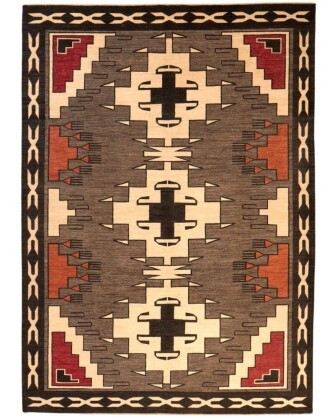


Navajo flat weave rugs carry a weaving tradition that runs back to the Spanish colonial period in the American Southwest, when Navajo weavers adapted techniques learned from Pueblo neighbors to produce dense, reversible textiles originally intended as wearing blankets. No pile, no knots tying face to backing — just interlocked weft threads built row by row on an upright loom. Shoppers gravitate toward these rugs for their geometric boldness, their flat profile that sits well under furniture, and the fact that each one is the record of a single weaver’s hand rather than a repeated factory pattern.
What Defines Navajo Flat weave Rugs
Construction here is weft-faced plain weave, not knotted pile. A weaver sets up vertical warp threads on a loom frame, then packs horizontal weft yarns tightly enough that the warp disappears entirely into the finished face — you can usually count 8 to 12 wefts per inch on an older, tightly spun piece, fewer on contemporary production rugs. There’s no backing to delaminate and no pile to crush, which is part of why 80-year-old trading-post pieces still turn up in sound structural condition. Weight runs lighter than a comparable knotted pile rug of the same dimensions, often 1 to 2 pounds per square foot depending on wool density, and the rug lies almost perfectly flat, around 1/8 to 1/4 inch thick.
Material is overwhelmingly hand-spun or mill-spun churro and Rambouillet wool, sometimes blended with commercial four-ply yarn on mid-20th-century examples made for wider retail sale. You’ll rarely see silk in authentic Navajo work — silk highlights belong to Persian and Turkish flat weave traditions, not this one — though some modern reproduction lines made overseas substitute cotton warp with wool or wool-blend weft to hit a lower price point. Color palettes lean on natural undyed wool tones (ivory, brown, gray, black) alongside aniline reds and golds introduced after commercial dyes reached reservation trading posts in the late 1800s. Motifs run geometric: stepped diamonds, zigzag lightning patterns, serrated crosses, and the banded horizontal stripe layouts associated with regional styles like Two Grey Hills, Ganado, Teec Nos Pos, and Crystal.
Key Features to Look For
Before buying, check these points against the piece in front of you rather than taking a listing description at face value.
- Reversibility — a genuine flat weave looks nearly identical on both faces; if one side is noticeably duller or shows a grid backing, it’s not a true tapestry weave
- Wool type and hand — churro wool feels coarser and slightly greasy to the touch compared to the softer, more uniform feel of commercial wool blends
- Weft density — tighter packing (10+ wefts per inch) signals slower, more skilled weaving and generally higher durability
- Size range — vintage and new production both run small, commonly 2×3 to 4×6 feet, with larger 6×9 and 8×10 room-size pieces far less common and priced accordingly
- Price positioning — new handwoven pieces from Southwest trading posts typically start around $800-$1,500 for a 3×5, while vintage pieces with documented regional provenance can run into five figures
- Low care demands — no pile means no matting or shedding, and routine upkeep is mostly vacuuming and occasional professional rug cleaning to pull out ground-in soil
Styling Navajo Flat weave Rugs in Your Home
These rugs read best in rooms where you want graphic pattern without visual weight — a reading nook, a hallway runner spot, or layered over a larger jute or wool rug in a living room. Because the weave lies flat, it works well under a coffee table or in front of a hearth where a thick pile rug would catch furniture legs or wear unevenly. Southwestern and Western-contemporary interiors are the obvious pairing, but the geometric patterns also hold their own in mid-century modern rooms, where the stepped-diamond and lightning motifs echo the period’s own interest in abstract pattern.
Keep the surrounding palette simple — leather furniture, raw wood, black iron fixtures — and let the rug’s pattern carry the room rather than competing with busy upholstery. A single Navajo flat weave hung as wall art above a sofa or bed also works, which is part of why many collectors treat these as much as textile art as floor covering. If you’re placing one in a high-traffic hallway or entry, add a thin non-slip pad underneath; without pile to grip the floor, flat weaves shift more readily than knotted rugs, and a good rug padding layer solves that without adding noticeable height.
Frequently Asked Questions
How do I tell a handmade Navajo flat weave from a machine-made reproduction?
Check the back first — true Navajo weaving is reversible with the same pattern visible on both sides, while machine-made reproductions usually have a distinct backing or a flatter, less defined reverse image. Hand-spun wool also shows slight irregularities in yarn thickness that a mechanically spun commercial yarn won’t have. If you’re buying a higher-value piece, a written appraisal documenting origin and construction is worth the cost for insurance and resale purposes.
What size Navajo flat weave rugs are typically available?
Most authentic pieces, vintage and new, fall in the 2×3 to 4×6 foot range because that’s the practical limit of a single weaver working a standard loom width. Larger room-size rugs exist but are rarer and command a premium. If you need a specific dimension for a particular room, a rug resizing specialist can sometimes adapt a larger flat weave, though this is uncommon practice for collectible pieces given how it affects value.
How do you clean and maintain a Navajo flat weave rug?
Regular vacuuming on a low-suction, no-beater-bar setting is the main maintenance task since there’s no pile to groom or fluff. For deeper soil or ground-in grit, have the rug professionally cleaned rather than washing it at home — wool flat weaves can bleed natural dyes if soaked improperly or dried too slowly. Rotate the rug every six months if it sits in direct sunlight, since the wool and some dyes will fade unevenly otherwise.
What should I expect to pay for an authentic piece, and are they durable long-term?
New handwoven rugs from reputable Southwest sources generally start around $800 for a small 3×5 piece and climb from there based on weaver reputation, wool quality, and weft density, while vintage pieces with documented regional history can sell well into five figures at auction. Durability is excellent — the tight weft-faced construction has no pile to crush or backing to separate, and well-kept pieces easily last multiple generations with proper storage and occasional professional attention.