
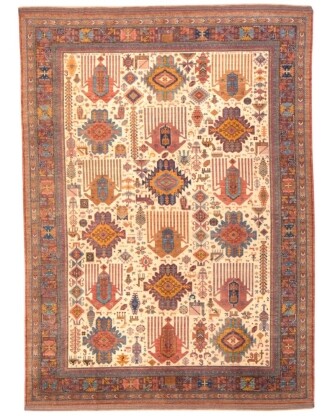


Tribal rugs carry the visual language of nomadic and village weavers who worked without formal pattern books, relying instead on motifs passed down through families and tribes – the Qashqai, Baluch, Turkmen, and various Anatolian and Caucasian groups among them. What you get is bold geometry: diamonds, hooked medallions, latch hooks, and stylized animal forms rendered in saturated, often earthy color. Shoppers gravitate toward this collection because the irregularities read as character rather than flaw, and because the patterns hide soil and wear better than finer, more symmetrical formal rugs. It’s a style built for rooms that get lived in.
What Defines Tribal Rugs
Most pieces in this collection are hand-knotted on horizontal ground looms or simple village looms, a method that predates the vertical looms used for city-made Persian and Oriental rugs. Knot density typically runs lower than you’d find in a fine Tabriz or Isfahan piece – often 50 to 120 knots per square inch rather than 300-plus – which is precisely why the motifs appear bolder and less refined. Pile height generally sits between 0.25 and 0.5 inches, and weight runs 60 to 90 ounces per square yard depending on wool quality and foundation. Many older tribal weavings also show asymmetrical knotting (the Persian or Senneh knot) rather than the symmetrical Turkish knot common in Anatolian work, a detail that helps with regional attribution.
Wool is the dominant material, frequently hand-spun from local sheep and dyed with natural pigments – madder root for reds, indigo for blues, walnut husk for browns. Cotton shows up as a foundation material for warp and weft in many Persian tribal weavings, while goat hair sometimes reinforces the selvedge edges for extra durability. Color palettes lean toward rust, brick red, camel, indigo, and ivory, with motifs like the boteh, ram’s horn, tarantula, and tree-of-life repeated in rows or scattered across the field. Older pieces, particularly Baluch prayer rugs and Qashqai bags converted into rugs, often carry a darker, more saturated palette than their Moroccan or Turkish tribal counterparts, which tend toward lighter wool and more open fields.
Key Features to Look For
Before buying, check for these specifics so you know what you’re actually paying for:
- Hand-knotted wool pile on a wool, cotton, or (rarely) silk foundation – ask the seller which foundation material was used, since it affects both price and longevity
- Knot count in the 50-120 KPSI range, which is normal for this category and not a sign of inferior craftsmanship
- Pile height of 0.25 to 0.5 inches, giving a slightly coarser hand than formal city rugs but better resilience to foot traffic
- Size range typically from small 2×3 and 3×5 accent pieces up through 6×9 and 8×10 room rugs, since tribal looms were historically smaller and large tribal rugs are scarcer and pricier
- Price positioning generally $800 to $4,000 for genuine hand-knotted pieces at retail, with antique or collector-grade tribal weavings running significantly higher
- Moderate to low care requirements compared to silk rugs, though natural dyes and hand-spun wool still call for gentle handling rather than harsh chemical treatment
Styling Tribal Rugs in Your Home
These rugs work hardest in rooms where you want pattern to anchor the space without competing with busy furnishings – living rooms, dens, and entryways are the natural fit. Pair a rust-and-indigo Baluch or Qashqai piece with mid-century or industrial furniture in leather, walnut, or black metal, and let the rug supply all the color. In a more layered bohemian interior, stacking a smaller tribal rug over a larger jute or flatweave piece adds texture without visual clutter, a trick that also protects the finer rug from direct furniture contact.
Neutral walls and simple window treatments let the geometry do the work, so resist the urge to add another heavily patterned textile in the same room. Kitchens and dining areas benefit from a tribal runner or 5×8 near the sink or table since the dense wool pile and busy pattern conceal daily spills and crumbs far better than a solid-color rug. If you’re working with a smaller space, a 3×5 tribal accent under a console table or at a bedroom threshold introduces the look without the commitment or cost of a full room-size piece.
Frequently Asked Questions
What size tribal rug should I buy for a living room?
For a standard living room, an 8×10 or 9×12 will allow all furniture legs to sit on the rug, which is the look most designers recommend. If budget or room size calls for something smaller, a 6×9 works as long as at least the front legs of your sofa and chairs rest on it. Tribal rugs under 5×8 are better suited to entryways, hallways, or as layered accent pieces rather than anchoring a full seating area.
How do I clean and maintain a hand-knotted tribal rug?
Vacuum weekly without the beater bar, which can fray fringe and loosen knots over time, and rotate the rug every six months for even wear and fading. Blot spills immediately with a clean cloth rather than rubbing, since natural dyes can bleed if scrubbed. For anything beyond light surface dirt, a professional rug cleaning service that understands hand-spun wool and natural dyes will get far better and safer results than at-home shampooing or a drop-off carpet cleaner.
Are tribal rugs durable enough for high-traffic areas?
Yes – the lower knot count and sturdy hand-spun wool actually make tribal rugs more forgiving underfoot than fine, tightly knotted formal rugs, which is part of why they were originally made for daily use in nomadic tents and village homes. The bold patterns also mask soiling and minor wear between cleanings. That said, any wool rug benefits from a quality pad underneath, and a good rug padding setup will extend the life of the pile and foundation considerably.
How can I tell if a tribal rug is genuinely handmade?
Flip the rug over – hand-knotted pieces show slight irregularities in the pattern on the back, and the knots themselves are visible as individual small loops rather than a uniform printed or woven grid. Machine-made rugs have a perfectly uniform backing, often with a mesh or latex coating, and the pattern repeats with mechanical precision. Fringe is another clue: on authentic hand-knotted rugs, the fringe is an extension of the foundation warp threads, not sewn on afterward. If you’re buying a higher-value piece or inherited one and want certainty, a formal rug appraisal will confirm construction, origin, and age.