



Do Curtains and Rugs Have to Match? A Rug Specialist’s Color-Pairing Guide
November 2, 2026
What Color Rug Goes With Blue Walls? A Rug Specialist’s Pairing Guide
November 5, 2026
The difference between rug and runner starts with shape, yet proportions tell only part of the story. Runners measure 2 to 3 feet wide and 6 to 14 feet long. Area rugs cover a broad rectangle. Throw rugs are small accent pieces under 4 by 6 feet. Looms, wear zones, and care schedules differ across the three formats too, and each one reaches my wash floor on its own timetable. This guide covers construction, placement, traffic wear, and the repairs I see most. Proper Rug Cleaning depends on knowing which format you own.
Key takeaways
- A runner is a rug whose length is at least three times its width, made for hallways, galley kitchens, and stairs.
- Area rugs anchor furniture in open rooms, with stock sizes like 5×8, 8×10, and 9×12 and ratios rarely above 1.5:1.
- Throw rugs are small accent pieces, generally 2×3 to 4×6 feet, and some lightweight cotton or polyester ones are machine washable.
- Runners are woven on narrow looms about 30 to 40 inches wide, so they tend to lie flatter than large rugs.
- Wool runners need careful hand washing or professional cleaning, and the article suggests a 12 to 18 month interval.
Matching rugs
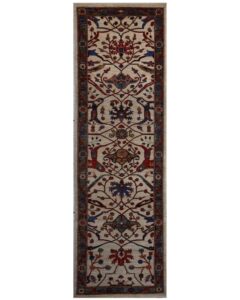
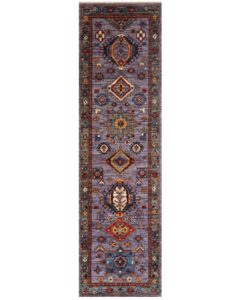
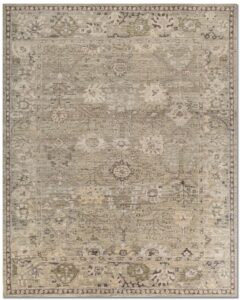
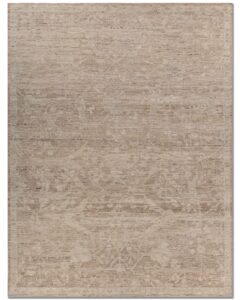
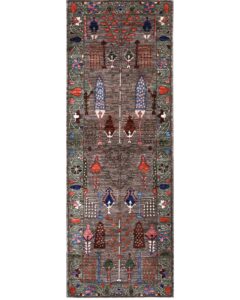
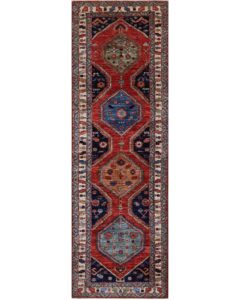
These rugs show the runner and room-size formats the article described, so you can see how each shape works in a real home.
What Is the Difference Between Rug and Runner in Plain Terms?
A runner is a rug whose length is at least three times its width, made for corridors, galley kitchens, and staircases. An area rug is proportioned to anchor furniture in an open room. Both come in hand-knotted wool, flatwoven, tufted, and machine-made versions. Fiber therefore tells you nothing about the format. Dimensions do. Learn more about Rug Cleaning.
Weavers and dealers use the terms consistently. Dealers sell a 2 foot 6 inch by 10 foot piece as a runner. They sell 5 by 8 and 8 by 10 pieces as area rugs. They call 2 by 3 and 3 by 5 pieces scatter or throw rugs. Persian weaving even has a word for the long format: kenareh, from the Persian word for “side,” because weavers made these pieces to lie along the edges of a larger central carpet. Retail listings sometimes call a 4 foot wide piece a runner, but that width sits closer to a gallery rug.
How Do Proportions Separate a Runner from an Area Rug?
Runner proportions sit between 3:1 and 6:1, while area rugs rarely exceed 1.5:1. That ratio drives loom width, weight, and wear. Standard runner widths in the United States are 24, 27, 30, and 36 inches (61 to 91 cm). Lengths step up in 2-foot increments from 6 to 14 feet, and custom pieces stretch past 20 feet.
Room-size rugs scale in both directions at once. A 9 by 12 foot hand-knotted wool rug covers 108 square feet, weighs roughly 60 to 90 pounds, and needs two people to carry. A 2.5 by 10 runner covers 25 square feet and rolls under one arm. Weight shows up on my wash floor. Full-size rugs dry flat on a rack for 24 to 48 hours, while runners usually dry and roll within 12 hours.
| Feature | Area Rug | Throw Rug | Runner |
|---|---|---|---|
| Typical width | 5 to 10 ft (152 to 305 cm) | 2 to 4 ft (61 to 122 cm) | 2 to 3 ft (61 to 91 cm) |
| Typical length | 8 to 14 ft | 3 to 6 ft | 6 to 14 ft, custom to 20+ ft |
| Length-to-width ratio | 1:1 to 1.5:1 | 1.5:1 | 3:1 to 6:1 |
| Common stock sizes | 5×8, 6×9, 8×10, 9×12 | 2×3, 3×5, 4×6 | 2.5×8, 2.5×10, 3×12 |
| Weight (wool pile) | 40 to 90 lb | 3 to 8 lb | 12 to 25 lb |
| Usual placement | Living, dining, bedroom | Bedside, bath, entry | Hall, stairs, kitchen |
| Recommended pad | 1/4 in felt-rubber | 1/16 in rubber grip | 1/8 in felt-rubber |
| Professional wash interval | 2 to 3 years | Home wash as needed | 12 to 18 months |
Where Does a Throw Rug Fit in the Rug-Versus-Runner Lineup?
Throw rugs are the smallest format, generally 2 by 3 to 4 by 6 feet. They sit beside a bed, in front of a sink, or inside a doorway as accents rather than structure. Manufacturers often make them from cotton, polyester, or microfiber on a latex backing. They share the runner’s portability but not its elongated shape.
Light weight lets many throw rugs survive a household washing machine, which no wool runner or knotted area rug can do. Our guide to the machine washable throw rug explains which backings handle a wash cycle and which delaminate after a few runs. Check the care label first, then flex a corner of the backing. Cracked latex signals a piece that will shed crumbs inside the drum. Wool runners need careful hand washing or a professional wash floor.
Does Loom Construction Change a Runner Compared with a Room-Size Rug?
Loom width defines construction, so yes: weavers make runners on narrow looms, often 30 to 40 inches across, and room-size rugs on looms 8 to 12 feet wide. One weaver can work a runner’s full width without reaching. A room-size rug needs two to four weavers sitting side by side.
Narrow looms tension the warps evenly across a short span. Well-made runners therefore lie flatter than wide rugs of equal quality and rarely develop the center buckling that large multi-weaver pieces show. Village runners from Hamadan, Karaja, or Heriz typically run 60 to 120 knots per square inch (KPSI). Finer Sarouk or Bidjar runners reach 160 to 250 KPSI. Border scale follows the loom as well, with runner borders proportionally narrower than those on room-size pieces.
Why Are Hand-Knotted Runners Woven on Narrow Looms?
Narrow looms cost less to build and fit inside a village home. One weaver finishes a 10-foot runner in 2 to 4 months. Runners therefore came historically from household looms in northwest Iran, the Caucasus, and Anatolia rather than from city workshops. Design followed the loom: a repeating field motif, often a column of medallions or an all-over herati pattern.
Antique Persian runners from Hamadan or Karaja, plus Caucasian Kazak and Talish runners, fill much of the Classic & Traditional Rugs that reach my bench for repair. Weavers often commissioned room-size rugs from the same regions with a central medallion. The runner and the area rug in a shared design therefore look related but never identical. Machine-made runners on Wilton or Axminster looms follow similar logic. Mills weave them on narrow-gauge equipment and cut them from a continuous roll.
Which Fibers and Weaves Suit a Runner Best?
Wool pile on a cotton foundation is the most durable runner construction. A corridor funnels every footstep into a path about 18 inches wide, and wool recovers from crushing far better than viscose, polyester, or polypropylene. Living-room rugs spread the same traffic over a much larger surface. Silk blends and viscose can survive there in ways they never will in a hallway.
Flatwoven runners deserve separate mention. Kilim runners have no pile to crush, weigh about 10 to 14 ounces per square foot, and flip over when one face wears. The trade-off is slip, since a pileless weave slides on hardwood. Any runner from the Kilim Rugs family needs a gripping pad more than other formats do. Hand-tufted runners with glued latex backing are the weakest corridor option, because the backing often cracks within 3 to 5 years of constant flexing.
More matching rugs
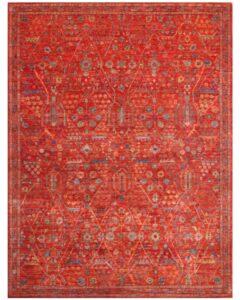
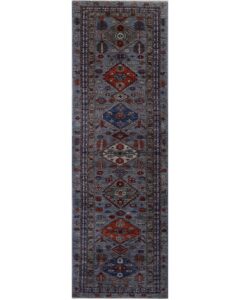
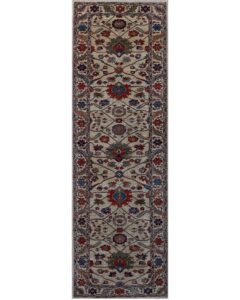
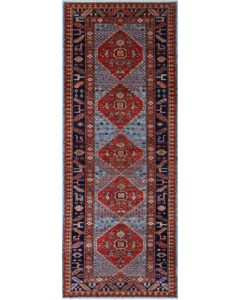
Another set of rugs that follow the same colors and style as this guide.
Which Rooms Call for a Runner and Which Call for an Area Rug?
Runners belong where movement is linear: hallways, stair treads, galley kitchens, mudrooms, and the strip beside a bed. Area rugs belong where people stop and gather, such as living rooms, dining rooms, and under a bed. The test is simple. Ask whether feet pass through the floor or settle on it.
Pass-through zones punish textiles differently from gathering spaces. A 40-inch-wide hallway that runs 10 feet holds about 33 square feet, and every trip through the house lands on that strip. Grit and crushing build fast there. Living-room rugs face spills, furniture indentations, and sun fading instead. Each problem calls for a different fiber, pile height, and care routine.
What Sizes and Clearances Work for Hallway and Stair Runners?
Hallway runners need a fixed margin of bare floor on every side. A 42-inch corridor takes a 30-inch runner, and a 36-inch corridor takes a 24- to 27-inch piece. On stairs, a 27-inch runner on a 36-inch tread is the traditional proportion, leaving 4.5 inches exposed on either side. Stair runners add brass or steel rods, or a tackless strip under each nosing, and a fitter who has done it before should install them.
Padding is not optional in either location. Felt-and-rubber pad trimmed short of the runner edge stops creeping on hardwood and absorbs the shearing force that breaks down the foundation. Professional Rug Padding cut to each runner’s exact footprint is one of the cheapest ways I know to extend a corridor piece’s working life.
- Hallway side margin: 4 to 6 inches of bare floor
- Hallway end margin: 12 to 18 inches of bare floor
- Stair coverage: 18 to 19 inches per step (tread depth plus riser height)
- Pad thickness: 1/8 inch, trimmed 1 inch inside the runner edge
Should I Choose a Runner or an Area Rug for My Space?
Three measurements decide the choice: clear width, clear length, and direction of travel. Choose a runner when the clear length exceeds three times the clear width and people walk end to end. Choose an area rug when furniture sits in the space, sized so the front legs of every seat rest on it. An 8 by 10 suits a standard room, and a 9 by 12 suits anything over 14 feet wide, with 12 to 18 inches of bare floor to the wall.
Layering gives runners a legitimate living-room job. A 2.5 by 8 vintage runner laid across a neutral jute or sisal rug adds pattern without a second large hand-knotted purchase, and owners can swap it seasonally. Test for dye transfer first when pairing a dark red or indigo field with a pale base. Fugitive dye in a humid room can migrate downward and leave a pink ghost on the base rug within a single summer. The commonest buying mistake I see is sizing to the room’s length instead of the walking line, which leaves a runner too wide for its corridor.
Does Foot Traffic Wear a Runner Differently from an Area Rug?
Foot traffic wears runners faster than area rugs, so runners need professional attention about twice as often. Traffic funnels rather than disperses, and the exposed ends take the brunt of every doorway and stair landing. A living-room rug might go 2 to 3 years between full washes. A hallway or kitchen runner in the same household usually needs washing every 12 to 18 months.
Damage patterns differ too. On area rugs I mostly treat sun fading along one edge, crushed pile under furniture legs, and pet accidents soaked into the center of the field. Runner complaints run to worn fringes, frayed selvedges (the finished long edges), a bald lane down the middle, and curled ends that become a tripping hazard. Narrow width under heavy traffic causes every one of them.
Why Does a Runner Need Washing More Often Than a Room Rug?
Runners need frequent washing because a hallway or kitchen channels grit, moisture, and cooking residue onto a small surface. Abrasive soil at the base of the pile cuts wool fibers each time someone walks across. Dry particulate does more fiber damage than most stains, and a runner collects it faster per square foot than a room-size rug. Watch for these signs of an overdue runner:
- Darker lane: a visibly dark center strip while the edges stay bright, which points to embedded grit
- Gritty base: pile that feels rough or sticky when parted, even after thorough vacuuming
- Odor: a musty or cooking-oil smell that returns within a day of airing outdoors
- Fringe color: gray or yellow tips where shoes and door sweeps make contact
- Pet accident: any urine, however well blotted, because salts reach a thin foundation quickly
Workshop washing differs from home shampooing in water control and drying. A home rug shampooer floods the foundation of a hand-knotted piece and often leaves detergent behind. We wash runners flat with controlled water volume and a pH-neutral detergent, then dry them under tension so the ends stay square. Between washes, vacuum along the pile direction with the beater bar switched off. Roll the ends back once a week to lift grit from the edge zone.
Can a Damaged Area Rug Be Cut Down Into a Runner?
Yes, a hand-knotted area rug with damage confined to one section can be cut down into one or more runners, provided the surviving portion is at least 24 inches wide and the foundation is sound. The technician cuts along a single line of weft. The raw edge then receives a new overcast selvedge or a woven end stop, and fringe or a kilim end keeps the warps from unraveling.
I handle this most often with 9 by 12 and 10 by 14 wool rugs hurt by a flood or moth infestation at one end. A 10 by 14 with 3 feet of ruined pile can yield a 7 by 10 area rug plus a runner from the remaining strip. Rug Resizing costs far less than a comparable replacement, and I quote it after inspecting the foundation. Machine-made rugs with latex backing make poor candidates. The backing crumbles at the cut line, and the new edge rarely holds for more than a year.
Final picks
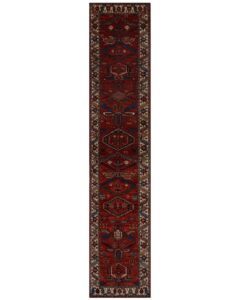
One last row of rugs chosen to go with the ideas above.
My Hands-On Experience with Runner Versus Area Rug Wear
My clearest lesson from years of washing and repairing both formats is that runners fail at their ends and area rugs fail in their middles. Nearly every piece on my bench confirms it. Clients also spend far less on the runner than on the room rug, then feel surprised when the cheaper piece needs replacing first despite covering a fifth of the floor space.
One case stays with me. A Denver client brought in a pair of matching Hamadan runners, each 2 feet 8 inches by 12 feet, woven around 1930 and used in the same hallway for 40 years. The one nearer the front door had lost close to an inch of pile height along its center lane, and both end fringes were gone. Its twin, 15 feet further into the house, still carried most of its original 3/8-inch pile. Same wool, same weaver, same decade, and the only variable was how many steps landed on each. We rewove the worn ends, secured new fringes, and sent them home with instructions to swap positions every spring.
Which Runner Repairs Reach My Workshop Most Often?
Curled ends, frayed selvedges, and pet urine in the foundation are the runner repairs I take in most. A trimmed pad and a wash every year or so would have prevented the majority. Curling is specific to the long format: doors, brooms, and vacuums work on the exposed ends until weft tension gives up and the corner lifts.
Steam and block the piece to fix curled ends, then stitch a narrow strip of cotton or canvas tape along the underside of the end. The repair takes about an hour and lasts for years. Selvedge repair re-wraps the edge warps with matching wool, and I recommend it the moment the first inch of exposed warp appears, since shedding from an open edge grows by several inches each season. Both jobs fall under our Rug Repair & Restoration service. In my experience, an area rug with an identical weave rarely needs either repair before its thirtieth year.
Runner Versus Rug FAQ
Three cutoffs sort almost every piece. Length at least three times width makes a runner. Anything under 4 by 6 feet is a throw rug. Everything else is an area rug.
The answers below apply those cutoffs to the questions I hear most at the counter.
Is a Runner Just a Narrow Area Rug?
Runners are not simply narrow area rugs. Weavers make them on narrow looms with repeating designs and proportionally narrow borders.
Any rug with a length at least three times its width counts as a runner, whatever its fiber or construction method.
Does a Runner Work as the Main Living Room Rug?
Living rooms rarely accept a runner as the main rug, because it cannot reach the front legs of seating arranged around a coffee table.
Runners do work as a secondary layer over a larger natural-fiber rug, along a window wall, or in a walkway between furniture and a door.
How Wide Is a Standard Runner Compared with an Area Rug?
Standard runners measure 24, 27, 30, or 36 inches wide, while the narrowest common area rug is 5 feet wide.
Custom hand-knotted runners reach about 4 feet wide, where dealers usually call the piece a gallery rug.
Should Runners Get Washed on a Different Schedule Than Rugs?
Runners should get professional washing every 12 to 18 months, versus 2 to 3 years for an area rug.
Wash chemistry stays identical for the same fiber, but runners need drying under tension to keep the ends square, plus weekly end-rolling to lift edge grit.
