

What Is an Oriental Rug? Origins, Styles and Buying Guide
November 17, 2026
Hand Knotted vs Tufted Rug: How to Tell Them Apart and Which Is Worth Buying
November 19, 2026
Navy blue curtains anchor a room like a dark frame around a painting, and the floor beneath them decides whether the composition feels deliberate or heavy. Clients ask what color rug goes with navy blue curtains more often than any other drapery-and-rug question, usually after a Pinterest board has handed them a dozen conflicting answers. I have spent years washing, reweaving, and placing hand-knotted and flatwoven rugs in real living rooms. My answer rests on three factors: how much light the rug reflects, how warm or cool its undertone runs, and how its fiber holds dye. Learn more about Rug Cleaning.
Key takeaways
- Ivory, oatmeal, camel, caramel, terracotta, rust, and mustard rugs look best with navy curtains because warm hues sit opposite navy on the color wheel.
- Warm neutral rugs such as camel, caramel, and undyed wool supply the warm undertone navy lacks and hide dust and foot traffic better than pure white.
- Choose ivory over optic white for white-walled rooms, since bleached white wool can dry out and yellow under strong sun.
- Repeat navy in small amounts on the rug, such as a thin border or guard stripes, but keep it under about 30 percent.
- Size the rug to extend 6 to 12 inches past the sofa, and check its color under your real bulbs and daylight.
This guide covers the rug colors that succeed beside navy, how to size and position them, and how fiber and dye change what you see. It closes with the care problems that come from setting a saturated dark textile above a pale pile.
Which Rug Colors Look Best With Navy Blue Curtains?
Ivory, oatmeal, camel, caramel, terracotta, rust, and mustard rugs look best with navy blue curtains. Warm hues sit opposite navy on the color wheel or close to it, so they read as intentional. Cool grays, charcoal, and a second shade of blue can also work, but they demand tighter control of texture and lighting.
Navy fabric absorbs most of the light that strikes it. The room needs a lighter floor to balance that darkness, and an ivory wool rug restores the balance from below. Weavers of Heriz and Serapi rugs in northwest Iran used the same logic. They set rust and ivory medallions against deep indigo grounds.
Our collection of Classic & Traditional Rugs holds hand-knotted pieces that already balance navy, ivory, and madder red. Village weavers refined those proportions over generations, so you can borrow their results directly.
Why Do Warm Neutral Rugs Suit Navy Drapes So Well?
Warm neutral rugs suit navy drapes because they supply the orange-to-yellow undertone that navy lacks. Camel, caramel, honey, and undyed natural wool complete the scheme without the visual noise of a saturated orange. They also forgive dust and foot traffic far better than a pure white rug.
Undyed or lightly dyed wool is my first recommendation for most households. Beni Ourain rugs weave cream wool with charcoal or dark brown lozenges, and their deep pile softens the hard vertical lines of floor-length panels. Oushak rugs from western Turkey provide the other historic workhorse for this pairing. You can compare both approaches in our Moroccan Rugs collection and the Turkish pieces alongside it.
- Beni Ourain: Middle Atlas Mountains, Morocco; cream wool with charcoal or brown lozenges; pile roughly 0.75 to 1.25 inches
- Oushak: western Turkey; apricot, camel, and faded gold palette; low to medium pile
- Undyed wool: natural cream to oatmeal; retains more of its own lanolin than bleached wool
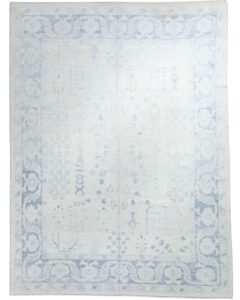
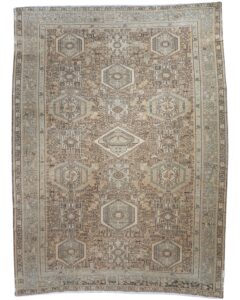
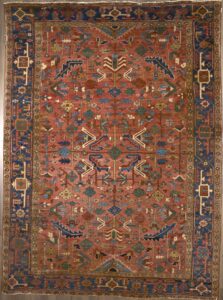
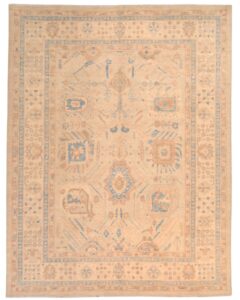
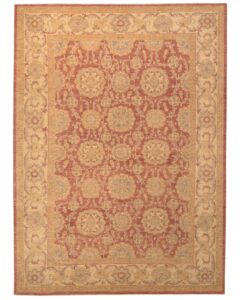
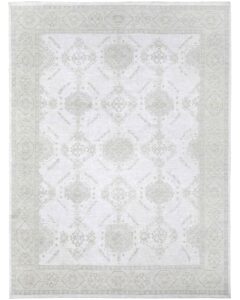
Matching rugs
These warm, light-toned rugs match the pairings described in the article and offset the depth of navy drapery.
When Should You Pick an Ivory Rug for Navy Curtains and White Walls?
An ivory or soft white rug suits navy curtains when the walls are also white and you want the drapery to be the room’s single dark element. The pale floor-and-wall envelope makes the panels read as a crisp graphic stripe instead of a shadow. Coastal and Scandinavian interiors rely on this formula, and it photographs beautifully.
I steer clients toward ivory instead of optic white. Optic-white wool is bleached, which can leave the fiber drier and more prone to yellowing under strong sun. Ivory, oatmeal, and undyed natural wool hold up better against soil and still reflect plenty of light. Stark rooms improve with a rug that carries a slender navy border of 2 to 4 inches. That border ties the floor back to the window without adding a third color.
How Do You Match a Living Room Rug to Navy Blue Drapes?
Matching a living room rug to navy blue drapes means repeating the navy at small scale in the rug and keeping the rug’s main field lighter and warmer than the drapery. Size the rug so it connects the seating group to the window wall. Follow a 60-30-10 proportion: rug and walls take the 60, drapes and upholstery take the 30, and brass, walnut, or one accent hue takes the 10.
Repeating the navy is the step most people skip. A camel rug with indigo guard stripes gives the eye a reason to travel from floor to window and back. Watch the ratio, though. Once navy passes roughly 30 percent of the rug, floor and window merge into one dark mass. Follow this sequence when you fit a rug to a room with navy panels already hung:
- Measure the seating group first. The rug should extend 6 to 12 inches beyond the sofa on each side, which usually lands at 8 x 10 ft (244 x 305 cm) or 9 x 12 ft (274 x 366 cm).
- Confirm the curtain length. Panels should kiss the floor or break by no more than half an inch.
- View candidate rugs under the room’s real bulbs. Warm 2700K LEDs push camel toward orange and make navy look nearly black, while 4000K lamps keep both truer.
- Judge the rug in daylight from the room’s own windows. A north-facing room cools every color, and no showroom reproduces that.
Our Try Rugs at Home service exists for the fourth step. A rug that looked perfect under gallery lighting can go muddy once afternoon sun filters through navy linen.
Which Pattern Scale Holds Up Beside Floor-Length Navy Panels?
Medium- to large-scale patterns hold up best beside floor-length navy panels. Solid navy drapery forms a large, uninterrupted block, and a tiny busy motif looks fussy against it. Central medallions, allover palmette designs, and bold geometrics with repeat units of 10 inches or more stay legible from across the room.
Small repeats are not forbidden; they simply need distance. A design with 2-inch motifs reads as texture from 10 feet away, which suits rooms where the curtains already carry the drama. Pairings fail when tight chevrons or herringbone sit under heavy navy velvet, because the two textiles compete at the same visual frequency. Modern rooms do better with low-contrast abstract and distressed designs. The Contemporary & Modern Rugs range behaves far better here than crisp small geometrics.
Where Should a Rug Sit Relative to Navy Window Drapery?
A rug should sit with its nearest edge 12 to 18 inches from the wall carrying the navy drapery. The panels then stack back to either side of the glass instead of resting on the pile. That gap gives the dark fabric breathing room and keeps the lighter field from looking trimmed to fit.
Keeping drapery off the rug also has a practical payoff. Navy cotton, linen, and velvet can release loose dye and lint in their first months of hanging. A hem that brushes ivory wool deposits blue fibers that migrate down into the knots. A dense felt-and-rubber pad of about 0.25 inch holds the rug square to the window wall. We fit these through our Rug Padding service, and the pad keeps the gap consistent instead of letting daily traffic creep the rug toward the curtains.
How Do Fiber and Sheen Change a Rug’s Color Beside Navy Drapes?
Fiber and sheen change a rug’s apparent color more than most buyers expect. A matte wool and a glossy viscose in the identical camel can look like two different colors beside dark navy drapes. The lustrous fiber reflects the curtains’ blue back into the room, while the matte fiber absorbs it.
The mechanism is physical. Wool fiber carries overlapping cuticle scales that scatter light in every direction, so the perceived color stays close to the dye color from any angle. Smooth filaments such as silk and viscose produce specular reflection, closer to a mirror than a sponge, and they borrow color from the large surface facing them. Pile direction compounds the effect. One end of a silk runner beside a navy window can look slate while the other looks pewter.
- Wool: diffuse light scatter; stable color; best choice for pale fields beside navy
- Wool-silk blend: silk highlights without full mirror effect; keep silk to a minor share
- Silk: directional sheen; picks up blue from drapes at some angles
- Viscose (“bamboo silk” or “art silk”): regenerated cellulose; weakens noticeably when wet; shows footprints in cream
Do Natural Dyes Pair Better With Navy Window Treatments?
Natural dyes pair very well with navy window treatments because they produce abrash, the slightly uneven, layered color of hand-dyed wool. The drapery’s flat factory dye is softened by that tonal variation instead of being mirrored by it. A rug with abrash also hides small shading differences between its field and the curtains.
The classic natural palette happens to be a navy-friendly palette. Madder root (Rubia tinctorum) gives the rust and brick reds that sit opposite blue on the wheel. Weld and pomegranate rind yield warm golds, walnut husk delivers camel and brown, and indigo from Indigofera tinctoria supplies blue accents that echo the curtains. Many vegetable-dyed pieces woven before synthetic dyes reached weaving regions in the late nineteenth century carry all of these at once. The Antique & Vintage Rugs in our inventory show how a century of gentle fading turns bright madder into the muted rust that navy drapery wants.
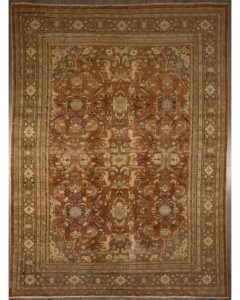
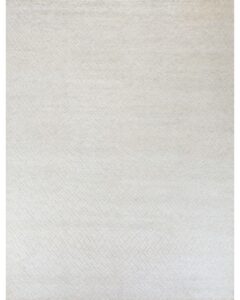
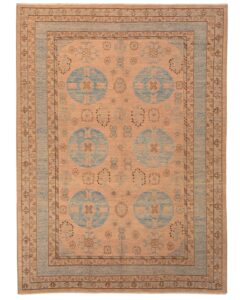
More matching rugs
Another set of rugs that follow the same colors and style as this guide.

How Do Popular Rug Colors Compare Beneath Navy Blue Curtains?
Ivory and camel are the lowest-risk rug colors beneath navy blue curtains. Terracotta and mustard deliver the most warmth, charcoal and mid-gray produce a tailored look that needs texture, and blush, sage, and a second blue are specialist choices. The table condenses what I check before recommending each color.
| Rug color | Light reflectance | Undertone | Styles that carry it well | Lighting it suits | Soil and fade notes |
|---|---|---|---|---|---|
| Ivory / cream | High | Warm neutral | Beni Ourain, Oushak, undyed wool flatweaves | Any; brightens north-facing rooms | Shows soil fastest; vacuum weekly, wash professionally every 2-3 years |
| Camel / caramel | Medium | Warm | Gabbeh, Oushak, Heriz field tones | 2700-3000K warm bulbs | Hides dust well; walnut-husk dyes are lightfast |
| Terracotta / rust | Low to medium | Warm, near-complementary | Heriz, Afshar, Moroccan Boujad | Strong daylight | Madder is very lightfast; test for bleeding before wet cleaning |
| Mustard / ochre | Medium | Warm | Gabbeh, vintage Anatolian, kilim | South-facing rooms | Weld yellows can drift toward olive after years of sun |
| Charcoal / mid-gray | Low | Cool to neutral | Moroccan, hand-loomed high-low textures | 3000-4000K plus layered lamps | Low contrast with navy; relies on texture; forgives soil |
| Blush / dusty rose | Medium to high | Warm-cool bridge | Faded Oushak, overdyed vintage | Morning light | Pink dyes tend to fade faster; rotate every 6 months |
| Sage / powder blue | Medium | Cool | Kilim, tribal flatweaves | Bright, multi-window rooms | Risk of a flat monochrome scheme; add warm wood tones |
Reading the table from top to bottom runs roughly from safest to most demanding. The first two rows succeed in nearly any living room. I would not choose either of the last two without seeing the rug in the room first.
Which Rug Color Fits Your Window Direction and Curtain Fabric?
Your window direction and curtain fabric decide the rug color more reliably than taste does. Use this decision rule: pick the rug’s warmth from the light, then pick its texture from the drapery fabric. Cool north light calls for warmer rugs, and strong south or west light calls for lightfast dyes.
- North-facing room: choose camel, apricot, or ivory to counter cool light
- South-facing room: choose lightfast madder, walnut, or indigo dyes and plan to rotate the rug
- West-facing room: expect low afternoon sun to make navy look darker; choose a lighter, warmer field
- Navy velvet drapes: choose matte wool with visible texture, because velvet already carries sheen
- Navy linen or cotton drapes: choose a flatweave or low pile, since the fabric looks relaxed and matte
The commonest mistake I correct is choosing the rug under showroom light and the curtains under daylight. Compare both against each other in the same room at two times of day. Hold a curtain swatch on the rug and squint; if the two blur into one mass, lighten the rug.
Which Rug Colors Should You Avoid Under Navy Blue Curtains?
Pure black, royal or cobalt blue, and saturated purple rugs are the colors to avoid under navy blue curtains. Black erases the contrast the room needs, cobalt fights navy at nearly the same hue, and purple sits too close on the wheel to read as a deliberate choice.
Bright, cool reds deserve caution too. Crimson or cherry beside navy and white tips a room toward a flag or sports-team palette almost immediately. The vivid red I might suggest to someone asking what color rug goes with yellow curtains would be wrong here. Keep red in the madder family instead: brick, rust, and rose have had their blue content pulled out by the dye chemistry itself.
Do Pinterest-Style Navy Curtain Rooms Work in Real Homes?
Pinterest-style navy curtain rooms work in real homes only when the rug choice survives ordinary lighting. The looks that translate best are the cream Moroccan shag, the faded apricot-and-camel Oushak, and the rust Heriz. The ultra-white viscose shag and the navy-on-navy monochrome scheme usually disappoint.
Styled photographs are typically shot with daylight-balanced fill light and edited with lifted shadows, so navy renders as soft slate and white reads as cloud. Under 2700K lamps at 8 p.m., that navy goes almost black. The white viscose then shows every path from sofa to door. Monochrome blue rooms can work, but they need at least three light sources, a textured rug such as a looped Moroccan wool, and a warm wood floor showing around the perimeter.
My Experience Choosing Rugs to Go With Navy Blue Curtains
My experience choosing rugs for navy blue curtains has taught me that lighting failures cause most of the regret I see. The rug people fall for online is rarely the one that survives their actual room.
One Denver client called me after hanging floor-length navy velvet across a 14-foot west wall. She had chosen a charcoal hand-loomed rug from a magazine spread, and by October the room read like a cave by 4 p.m. We trialed three pieces over a weekend. A circa-1930s Oushak at 9 x 12 feet, with an apricot field and faded indigo guard stripes, fixed the problem the moment we unrolled it. Its rust and camel tones threw warm light back onto the velvet, and the navy stopped swallowing the room. She moved the charcoal piece to a bedroom with pale linen panels, where it looked entirely at home.
The wash floor shows the other side of the story. Cream Beni Ourain rugs often arrive with a faint blue cast along one edge. The cause is nearly always a navy cotton or linen hem that rested on the pile for months. Loose dye and fiber work into the wool and will not vacuum out. A proper immersion wash with a pH-neutral surfactant removes most of it. The pile along that edge rarely matches the rest if the rug has also been in the sun.
Which Navy Curtain and Rug Pairings Have Lasted Longest in My Clients’ Homes?
Three pairings have lasted longest in my clients’ homes over 5 to 10 years. Camel or apricot Oushaks beneath navy linen top the list. Rust Heriz and Serapi pieces beneath navy wool or velvet come second, and solid camel Gabbehs beneath navy cotton work well in casual rooms.
All three share one trait: a lightfast warm dye on a wool pile at least 0.4 inch deep. Gabbeh rugs from Iran’s Fars province have thick pile and large open fields. They forgive children and dogs, and their walnut and madder dyes barely shift over years of sun. The Gabbeh Rugs collection supplies the pieces I pull first for families who want warmth under navy without fretting over every footprint.
How Do You Care for a Light Rug Near Navy Blue Curtains?
Caring for a light rug near navy blue curtains means weekly suction-only vacuuming, keeping hems off the pile, rotating the rug 180 degrees every 6 months, and booking a professional immersion wash every 2 to 3 years. Regular washing removes soil before it grays the ivory field.
Beater-bar vacuums abrade wool tips and can drive loose blue lint deeper, so a suction-only setting or canister tool suits a cream or camel pile. I would not attempt a rental machine on a light wool rug in this situation, because excess moisture encourages trapped navy fiber to bleed into surrounding wool. Our Rug Cleaning process starts with a dye-stability test on every color and uses controlled drying within 24 to 48 hours, which keeps a pale field pale.
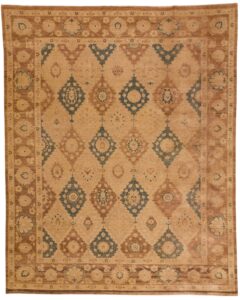
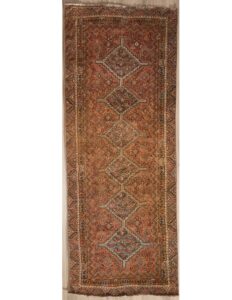
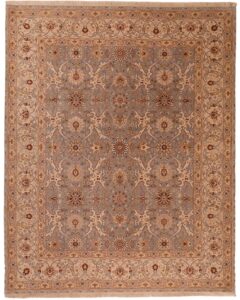
Final picks
One last row of rugs chosen to go with the ideas above.


Can Navy Curtain Dye Transfer Onto a Light Rug?
Navy curtain dye can transfer onto a light rug, most commonly from new cotton, linen, and velvet panels during their first months of use. Humid rooms raise the risk, because moisture frees loose dye from the fabric.
Run a quick test: press a damp white cotton cloth firmly against the hem for 30 seconds. Blue on the cloth means the fabric fails the crocking standard that textile labs measure under AATCC Test Method 8. Launder or dry-clean those panels before they hang near a pale rug. Once transfer has occurred, skip household spotters, because many contain optical brighteners that permanently alter ivory wool. Blot dry and learn how to wash rug fibers correctly, or bring the piece in for a controlled wash.
How Does Sunlight Through Navy Drapes Fade a Rug Over Time?
Sunlight through navy drapes fades a rug unevenly. Closed panels block most light, but open panels leave a sharply defined bright band across the floor. The exposed strip loses color while the shaded portion does not, and the result is a visible line.
Unlined linen still transmits some ultraviolet light when closed, so lining the drapes protects the rug as much as the fabric. Window film rated to block up to 99 percent of UV, combined with the twice-yearly rotation above, keeps camel or ivory fields even for years. Blush and mustard fade first in south- and west-facing rooms where the curtains stay open, so watch those two colors most closely.
Quick Answers About Rugs for Navy Blue Curtains
These are the questions I hear most often once a client settles on navy drapery and stands in front of a stack of rugs.
Does a gray rug go with navy blue curtains in a living room?
A gray rug goes with navy blue curtains if it has visible texture and sits under at least three warm light sources. A flat mid-gray loop pile under one ceiling fixture feels cold and dim. Warm greiges with a brown base work more reliably than blue-based grays.
Which rug color suits navy blue curtains and white walls best?
Ivory or oatmeal suits navy blue curtains and white walls best. It keeps the drapery as the single dark element and avoids the soiling and yellowing problems of optic white. A thin navy border or scattered indigo motifs tie the floor to the window.
Should the rug match the navy curtains exactly?
The rug should not match navy curtains exactly, because matching produces a dark, undifferentiated room. Echo the navy at small scale, ideally under 30 percent of the rug’s surface. Keep the dominant field lighter and warmer than the drapery.
Is a patterned rug or a solid rug better with navy drapes?
A patterned rug with a medium-to-large repeat usually works better with navy drapes. Solid drapery already supplies a large block of color, and a traditional or geometric pattern gives the eye somewhere to rest. Solid rugs work when they bring strong texture, such as a Moroccan loop pile.
How large should a living room rug be beneath navy curtains?
A living room rug beneath navy curtains should sit under the front legs of all seating and extend 6 to 12 inches past the sofa. That usually means 8 x 10 ft or 9 x 12 ft. Stop the rug 12 to 18 inches short of the curtain wall.
Sources on Navy Dye and Rug Color Guidance
Both references below cover the color and dye background behind the advice in this guide.
- Wikipedia: Navy blue
- Wikipedia: Indigo dye
