


Area Rug vs Throw Rug vs Runner: What Is the Difference Between Rug and Runner?
November 3, 2026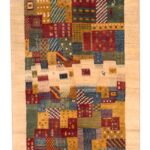
Gabbeh Wool Rugs: What Makes Them Soft, Tribal and Timeless
November 6, 2026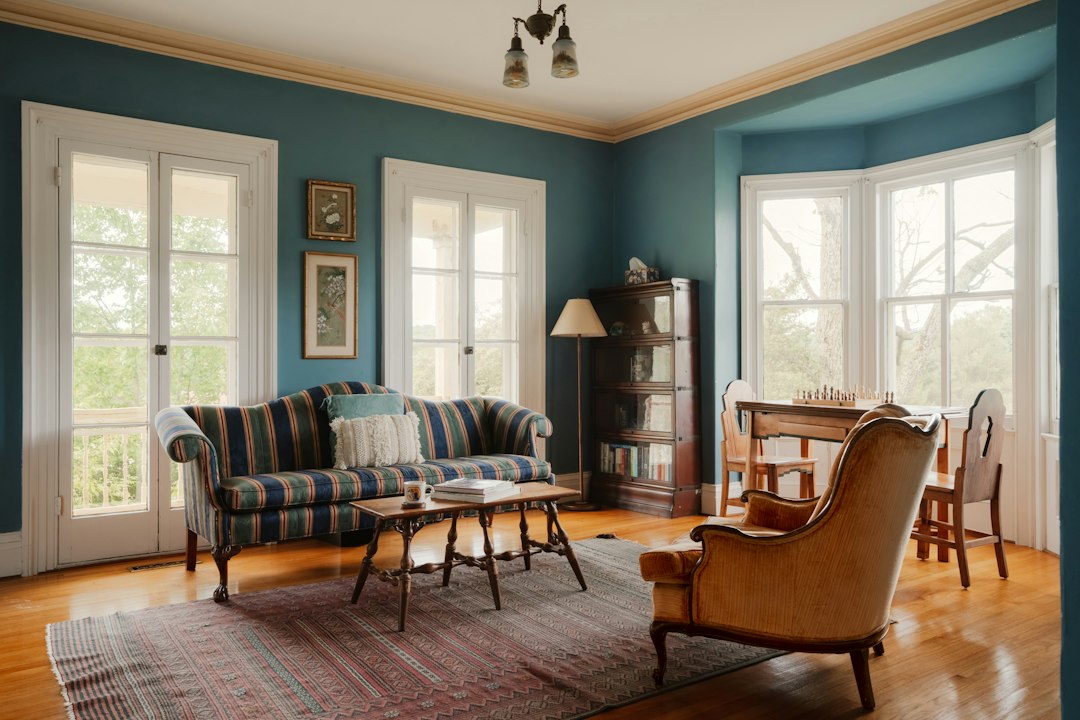
The question of what color rug goes with blue walls reaches my workshop every week, usually from someone who has already returned two rugs that looked wrong on the floor. Warm neutrals, rust, terracotta, muted mustard, and patterned wool rugs flatter blue paint more reliably than a second shade of blue does. Undertone, paint depth, room light, and fiber all shift that answer. Learn more about Rug Cleaning.
Key takeaways
- Warm neutrals like cream, ivory, camel, and warm gray suit blue walls in nearly every room without competing for attention.
- Rust, terracotta, and muted mustard add warmth when the floor needs its own voice, while lemon yellow tips a blue room toward nautical cartoon.
- Check the wall’s undertone: green-leaning blues like terracotta or rust, gray-leaning blues like camel or honey, and violet-leaning blues like gold, ochre, or olive.
- Aim for a rug 20 to 30 LRV points away from the paint, since one within 10 points tends to blur into the wall.
- Judge rug samples under both warm and cool bulbs and at different times of day, because bulb temperature and window direction shift how blue and rug colors look.
I have washed, repaired, and restored rugs from blue-walled homes for years. Below, I cover pale blue versus navy, living room sizing, dye stability, and the mistakes that bring rugs back to my wash floor.
Matching rugs
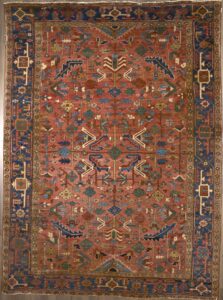
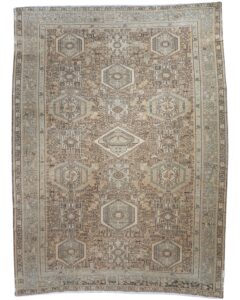
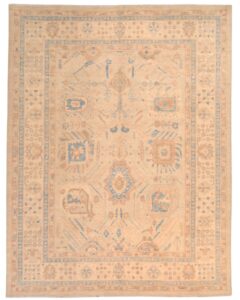
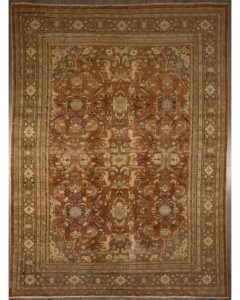
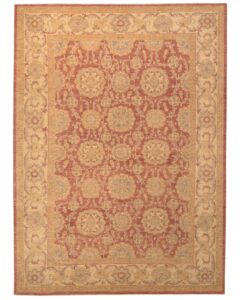
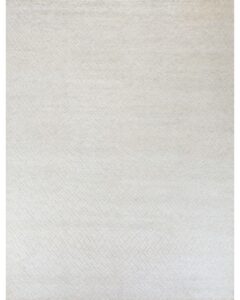
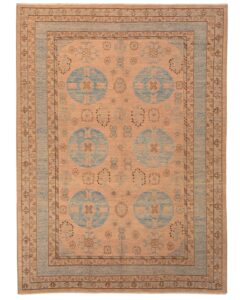
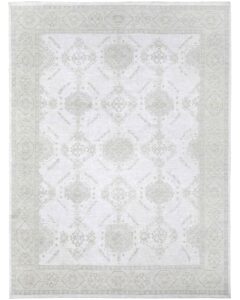
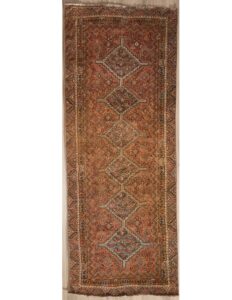
These warm neutral and earthy patterned wool rugs suit blue walls, adding warmth and contrast without blending into the paint.
What Color Rug Goes With Blue Walls in Most Rooms?
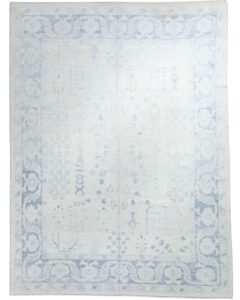
Cream, ivory, camel, and warm gray rugs suit blue walls in nearly every room. They sit opposite blue in temperature without competing for attention. Rust, terracotta, and ochre add warmth when the floor needs its own voice. A traditional rug with an ivory field and small blue accents ties floor and walls together without matching them.
Color theory explains the pattern. On the traditional red-yellow-blue wheel, orange sits across from blue. A softened orange such as caramel, brick, apricot, or rust therefore reads as a complement. A vegetable-dyed Heriz with a madder-red ground looks settled beneath navy paint, not theatrical.
Light Reflectance Value (LRV) measures paint depth on a scale from 0 (black) to 100 (white). A rug 20 to 30 points away from the paint gives comfortable contrast. A rug within 10 points tends to blur into the wall. That error explains most navy-rug-under-navy-wall rooms.
Why Do Warm Neutrals Pair Well With Blue Paint?
Warm neutrals pair well with blue paint because they supply the yellow and red that blue lacks. Cream, oatmeal, camel, and sand pull the space forward. Blue recedes, so a neutral floor keeps the room from feeling like a swimming pool.
Fiber changes how warm a neutral looks. Undyed New Zealand wool runs bright white to pale cream. Afghan and Turkish highland wool carries an ivory-to-honey cast from its natural lanolin. That honey tone makes a hand-knotted ivory rug look richer than a bleached synthetic. Jute and sisal lean tan, which flatters powder blue but can look dull beside a gray-leaning blue.
Mustard and ochre extend the same idea in saturated form. A Gabbeh with a saffron ground suits blue paint the way a yellow textile does, and my guide on what color rug goes with yellow curtains follows similar logic. Keep the yellow muted, because lemon yellow tips a blue room toward nautical cartoon.
How Does a Blue Wall’s Undertone Change Your Rug Choice?
The undertone of a blue wall decides whether the rug should lean warm, cool, or gray. Every blue paint carries a bias toward green, violet, or gray. The bias becomes obvious once the rug arrives. Hold a sheet of white printer paper against the wall in daylight to see it.
- Green-leaning blues (teal, aqua, duck egg, Farrow & Ball Dix Blue): terracotta, coral, or a rust-and-ivory Kilim
- Gray-leaning blues (slate, denim, smoky blue): camel, honey, or a tobacco-brown tribal rug
- Violet-leaning blues (periwinkle, cornflower, lavender-blue): soft gold, ochre, or olive
- True blues (Pantone Classic Blue 19-4052, cobalt): cream, ivory, or natural jute
Reasoning behind each pairing is simple. Red-orange answers blue-green, and yellow-green answers violet. Gray-leaning blue needs warmth to avoid going flat. True blues already carry all the saturation the room can hold, so the rug stays quiet.
Does Room Lighting Change Rug Colors Against Blue Walls?
Room lighting changes rug colors against blue walls through bulb temperature and window direction. A 2700K warm bulb pushes most blues toward gray-green by evening. A 4000K lamp keeps them crisp and cool. Judge every rug sample under both before you decide.
Window direction adds a second variable. North-facing rooms receive cool, steady light that deepens blue and mutes warm rugs, so I lean toward richer rust or caramel there. South-facing rooms bring strong, warm light that can wash out pale blue, which leaves room for a cooler ivory or warm gray rug. Lay the sample beside the wall and view it from the doorway, about 8 ft (2.4 m) away, at morning, noon, and night.
Which Rug Colors Suit Light Blue Walls?
Light blue walls suit mid-tone warm neutrals such as camel, caramel, taupe, and oatmeal. Soft terracotta, dusty rose, and patterned rugs on an ivory ground also work. Pale blue paint is airy and low in saturation, so the rug should add weight and warmth without overpowering the walls.
Powder blue, sky blue, and duck egg typically sit between 55 and 75 LRV, so they bounce plenty of light. A bright white shag leaves the eye nothing to rest on. A charcoal or black-ground Moroccan can look like a hole in the floor. I aim for a rug in the 30 to 50 LRV range.
- Camel or caramel wool: warm anchor with moderate contrast
- Washed-out brick: gentle drama beneath sky blue
- Antique Oushak with an apricot field: soft color that catches daylight
- Blush or camel hand-knotted wool for bedrooms and nurseries: pile height 0.4 to 0.6 in (10 to 15 mm)
Should a Rug Look Darker Than Pale Blue Walls?
A rug should generally look a step or two darker than pale blue walls. A floor lighter than the walls makes a room feel top-heavy and unanchored. Aim for the rug to be the darkest large surface, apart from the sofa or a wood floor.
Darker does not mean dark. A caramel or honey rug under light blue walls gives moderate contrast, yet the floor still reads as the foundation. A rust or brick rug beneath sky blue adds drama, and people respond to that sunset-over-water pairing instinctively.
Care schedules also favor mid-tones. Ivory wool in a family room usually needs a professional wash every 12 to 18 months before traffic lanes set. A caramel or patterned rug can stretch to 2 to 3 years between washes with regular vacuuming.
Do Geometric Rugs Suit a Light Blue Room Best?
Geometric and tribal patterns suit a light blue room best. Pale paint stays calm enough to let a strong motif carry the floor. Beni Ourain diamonds, Navajo-style stepped bands, and Kilim lozenges look crisp against it. A dense floral Persian design can feel busy beside such a quiet wall.
Cream Beni Ourain rugs from Morocco’s Middle Atlas are my most requested piece under light blue walls. Undyed ivory wool and a charcoal lattice warm the room without adding a competing color. Start with Moroccan Rugs. Typical ranges run about $3,000 to $6,000 for a hand-knotted 8 x 10 ft (244 x 305 cm) piece, versus $400 to $900 for a machine-made copy.
Abstract designs with watercolor-style bleeds also work, provided the palette holds one warm tone. An all-blue-and-gray abstract dissolves into the wall. I steer clients toward Contemporary & Modern Rugs with a rust, ochre, or blush passage for that reason.
How Can a Rug Balance Dark Blue or Navy Walls?
Rust, terracotta, brick red, camel, warm ivory, and gold balance dark blue walls. Traditional patterned rugs on a red or cream ground do the same job. Navy, indigo, and midnight paint absorb most of the room’s light, so the rug must reflect warmth upward.
Paint depth shows the scale of the problem. Both examples below sit within a few points of black:
- Benjamin Moore Hale Navy HC-154: LRV of about 8
- Sherwin-Williams Naval SW 6244: LRV of about 4
- Rug range I recommend against them: LRV of 40 to 70
Deep blue is also the one case where a strongly saturated rug makes sense. A saffron Gabbeh or madder-red Heriz looks garish against beige walls. Navy carries enough visual weight to hold either one.
Does a Rust or Terracotta Rug Work With Navy Walls?
A rust or terracotta rug works with navy walls better than almost any other pairing. The two colors are near-complements at opposite ends of the warm-cool scale. Nineteenth-century Heriz and Serapi weavers placed indigo medallions on madder-red grounds deliberately, because each color intensifies the other.
Genuine Heriz and Serapi rugs use that scheme at roughly 30 to 80 knots per square inch. The coarse, angular drawing survives furniture and foot traffic for many decades. Browse Classic & Traditional Rugs and budget an estimated $4,000 to $12,000 for a room-size antique, depending on age and condition.
Red-on-floor, blue-on-wall follows the principle in my advice on what color rug goes with red curtains, with one twist. The rug should be the more muted element, so choose brick, cinnamon, or rust over cherry.
Can a Blue Rug Sit Below Deep Blue Walls Without Disappearing?
A blue rug survives below deep blue walls only when it is three or four shades lighter than the paint. It also needs a second color, such as ivory or rust, across at least a third of its surface. A navy rug under navy walls flattens the room into one dark mass. I am asked to fix that pairing more than any other.
Tonal rooms can still look beautiful. An overdyed vintage rug in faded denim or chambray, with the original ivory pattern showing through, separates floor from wall. Avoid dark indigo-overdyed pieces here. Heavily overdyed rugs often release loose dye through their first two or three washes, and I have seen them stain pale pads and oak floors.
More matching rugs
Another set of rugs that follow the same colors and style as this guide.

How Do Rug Colors Compare Against Light and Dark Blue Walls?
A side-by-side comparison shows how each rug color behaves against light and dark blue walls. The table covers contrast, soil visibility, sun-fade behavior in wool, and typical professional wash interval.
Treat the wash intervals as typical ranges, not guarantees. Household traffic, pets, and window exposure move them in either direction.
| Rug color | Against light blue walls | Against dark blue walls | Soil visibility | Sun-fade behavior (wool) | Typical professional wash interval |
|---|---|---|---|---|---|
| Cream / ivory | Low contrast; needs texture or pattern | High contrast; brightens the room | High | Stable; may yellow slightly | 12-18 months |
| Camel / caramel | Moderate contrast; warm anchor | Strong warm glow | Low | Minor lightening | 2-3 years |
| Rust / terracotta | High contrast; bold | Classic complement | Low | Shifts toward peach over years of strong sun | 2-3 years |
| Mustard / ochre | Lively; keep it muted | Rich and dramatic | Low to moderate | Moderate lightening | 2-3 years |
| Warm gray / greige | Can read cold; add warm accents | Mid-contrast, modern | Moderate | Stable | 18-24 months |
| Patterned (Heriz, Oushak, Kilim) | Crisp if geometric | Traditional pairing | Very low | Reds soften before blues do | 3-4 years |
| Light blue tonal | Nearly disappears | Works only if 3-4 shades lighter | Moderate | Indigo drifts toward gray-teal | 2-3 years |
What Rug Suits a Living Room With Blue Walls?
Choosing a rug for a living room with blue walls starts with one decision: will the rug or the walls be the focal point? Quiet walls let the rug carry pattern or saturated warmth. Statement walls call for a calm cream, camel, or jute rug. Size comes next, then color.
The 60-30-10 rule sharpens the choice. Walls fill the dominant 60 percent. Rug and sofa share the secondary 30 percent, where camel, rust, or ivory belongs. Cushions, art, and lamps fill the final 10 percent. A second large blue surface in the 30 percent slot makes the room monotonous.
My decision rule pairs room conditions with a starting color:
- Pale blue walls with children or dogs: camel field or ivory-and-charcoal pattern
- Navy walls in a formal room: rust, brick, or ivory Heriz-style design
- True blue walls in a bright room: cream or natural jute
Living rooms take the heaviest traffic, so practicality counts. Patterned rugs in rust, camel, and ivory hide crumbs, pet hair, and wine spills far better than a solid pale field.
Which Fibers Hold Rug Color Longest Beside Blue Walls?
Well-dyed wool, colored with natural madder and weld or modern chrome dyes, holds color longest beside blue walls. Viscose and cheap printed synthetics fade fastest. Blue paint often goes into rooms with large windows, so lightfastness is a practical concern, not a theoretical one.
Lightfastness is rated on the Blue Wool Scale from 1 to 8 under ISO 105-B02, and a higher number means slower fading. Rust and terracotta wool drifts toward peach, cream stays stable, and indigo drifts toward gray-teal. Rotate the rug 180 degrees every six months to even out exposure. UV-blocking window film protects both rug and paint.
Faded wool cannot regain lost dye. A professional Rug Cleaning brightens dulled pile, but prevention remains the only real cure.
What Size Rug Keeps a Blue-Walled Living Room in Proportion?
An 8 x 10 ft (244 x 305 cm) or 9 x 12 ft (274 x 366 cm) rug keeps most blue-walled living rooms in proportion. Leave 12 to 18 inches (30 to 45 cm) of bare floor between rug and walls. Dark paint visually shrinks a room, so the exposed floor must read as a border, not a gap.
A short rug turns the floor into an island floating in blue. Run the rug beneath the front legs of the sofa and every chair at minimum. Use all four legs where space allows.
Padding changes how color reads too. A dense felt-and-rubber pad of 0.25 to 0.4 inch (6 to 10 mm) lifts the pile so it catches light evenly. Our Rug Padding service cuts pads to size, so no ridge shows at the edge.
Final picks
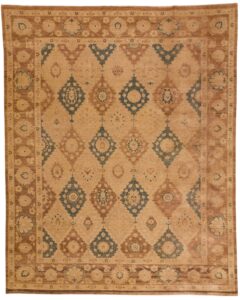
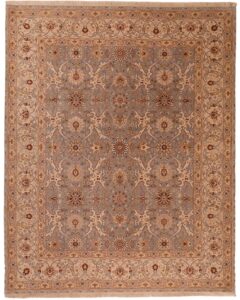
One last row of rugs chosen to go with the ideas above.


My Experience Choosing Rugs for Blue Walls
Years of washing, repairing, and delivering rugs into blue rooms taught me that the pairing fails for practical reasons far more than aesthetic ones. Color theory carries people most of the way. Soil, sun, dye behavior, and scale trip them up, and I learned that by watching the same rugs return to my workshop.
One example stays with me. A client with a Hale Navy dining room bought an antique Oushak with a pale apricot field and sage border. It remains the best navy pairing I have delivered. The Turkish wool’s honey cast warmed the room, and the large-scale drawing stayed legible from the doorway. When the rug returned for washing four years later, the only wear was flattened pile under the chair legs, which we steamed back up in an afternoon.
Another job went the other direction. A young family put a pure white, low-pile Beni Ourain under powder-blue walls in a playroom, and it looked stunning for about nine months. By the time it reached our wash floor, the path from the door to the toy shelf sat two shades darker than the rest, and window light had given the undyed wool a yellow cast. We restored it. Now I recommend an ivory-and-charcoal pattern or a camel field for any light blue room with children or dogs.
Where Do Homeowners Go Wrong Pairing Rugs With Blue Paint?
Homeowners go wrong pairing rugs with blue paint in three ways: matching too closely, buying too small, and ignoring dye stability. Each arrives in my workshop in a predictable form. A navy-on-navy room feels airless. A 5 x 8 ft rug gets lost in a 14-foot living room. An overdyed rug bleeds onto a pale floor.
The bleeding problem is invisible at purchase, so I test for it. I press a damp white cotton cloth onto the darkest and reddest areas for 60 seconds. If the cloth picks up color, the rug needs a stabilizing wash before it goes near a light floor. Indigo and cheap red dyes are the usual offenders, and they migrate most in humid summer months.
Scale is the easiest mistake to prevent. I encourage clients to borrow a candidate through our Try Rugs at Home service and live with it beside their blue walls for a few days. Check it under daylight and lamplight before committing.
Common Questions About Rug Colors for Blue Walls
These answers cover the pairings I get asked about most. Each one names the single factor that decides the outcome.
Short replies keep the deciding detail easy to find.
Is a Gray Rug a Good Match for Blue Paint?
A gray rug matches blue paint only when it is a warm gray with a brown or taupe undertone, often called greige. Cool blue-grays make the room feel clinical.
Add rust, camel, or ochre through cushions and a throw if you already own a cool gray rug.
Do Blue Rooms Need a Blue Rug?
Blue rooms do not need a blue rug, and a second blue surface is usually the weakest option. It removes the contrast the room relies on.
Mixed patterns with a little blue in the border give cohesion while keeping floor and walls distinct.
Will a White Rug Look Washed Out Beside Pale Blue Walls?
An optic-white rug usually looks washed out beside pale blue walls, because both surfaces sit close in brightness.
Choose ivory or oatmeal, add a geometric pattern or high-low texture for shadow, or step down to camel.
Do Patterned Rugs Stay Cleaner Under Navy Paint?
Patterned rugs hide soil under navy paint but do not stay cleaner, because pattern disguises dirt rather than reducing it.
Grit still abrades wool unseen, so vacuum once or twice a week on suction-only and keep the fiber’s wash schedule.
Is Jute a Safe Rug Choice for a Blue Room?
A jute rug works well with true and light blue walls, where its tan tone acts as a warm neutral. Typical cost runs $200 to $600 for an 8 x 10 ft piece.
Jute browns when wet and cannot be wet-washed, so keep it out of entryways, basements, and damp bathrooms.
