

Rug Repair Guide: What Damage Can Be Fixed and How
November 10, 2026
Sisal vs Seagrass Rug: Which Natural Fiber Holds Up Better in a Real Home?
November 13, 2026
The question of what color rug goes with yellow walls has a practical answer after nineteen years of washing, reweaving, and color-matching rugs across the Front Range. Cool blues, mid-tone greys, ivory, and earthy terracotta usually succeed. Bright reds and saturated oranges rarely do. Yellow reflects more light than most wall colors, so the floor must either steady the room or leave it glaring. This guide covers undertones, light reflectance, weave choices, living room sizing, dye durability, and the pairings I have watched fail. Learn more about Rug Cleaning.
Key takeaways
- Blue, warm grey, ivory, and terracotta rugs go best with yellow walls in most rooms, while bright reds and saturated oranges rarely work.
- A darker, low-reflectance rug such as navy or charcoal gives yellow’s bounced light somewhere to land and keeps the room from looking flat.
- Check your yellow’s undertone by holding a paint chip against white paper, since undertone matters more than brightness when choosing a rug.
- Terracotta suits warm gold, ochre, or butter walls but looks muddy against green-leaning lemon or citron yellows, so keep it to about 40 percent of the rug.
- Pale butter or cream-yellow walls pair well with mid-blue, taupe, sage, or ivory rugs with blue accents, while pale yellow and light beige rugs vanish into the paint.
Which Rug Colors Go Best With Yellow Walls in Most Rooms?
Blue, warm grey, ivory, and terracotta are the rug colors that go best with yellow walls in most rooms. Navy, denim, and slate blue cool the space without clashing. Warm grey and oatmeal ivory soften the light bounce. Terracotta and rust share yellow’s orange base and add weight to the floor. Each option gives the eye a place to rest.
Yellow paint reflects a high share of incoming daylight, measured as light reflectance value (LRV). A rug with a low LRV, such as a navy-ground Heriz or a charcoal Moroccan, gives that light somewhere to land. Walls and floor at equal brightness leave the eye without a resting point, and the room reads flat and washed out. A darker floor restores depth and makes the yellow look deliberate.
Why Do Blue and Grey Rugs Suit Yellow Paint?
Blue and grey rugs suit yellow paint because they sit opposite yellow in temperature. They lower the perceived warmth of the room. They add contrast without introducing a third competing hue. Indigo-dyed wool also carries a faint green cast that harmonizes with the green base hidden in many lemon and citron paints.
Classic examples are easy to name. A Persian Nain with an ivory field and cobalt medallion delivers the effect. So does a Turkish Oushak in soft slate and apricot. A Beni Ourain with charcoal diamonds on undyed cream wool does it at a lower price. Hand-knotted 8 by 10 foot pieces in these styles run roughly $1,200 to $9,000, an estimate that shifts with knot density, age, and condition. The rug carries the cool note, the wall carries the warm one, and neither fights the other.
Does a Terracotta Rug Work Against Yellow Walls?
A terracotta rug works against yellow walls when the paint leans warm, meaning gold, ochre, or butter. Both colors spring from one orange base and read as a single sunbaked palette. Against a cool, green-leaning yellow, the same rug looks muddy. Lemon and citron rooms call for a different choice.
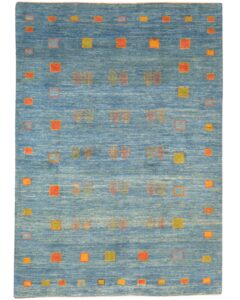
Madder root produces the best terracotta I handle, a brick-to-rust range that softens as it ages. Tribal weavers in southern Iran favor this color. The open fields and heavy 8 to 10 mm pile of Gabbeh Rugs let a rust ground carry a room without busy pattern. Limit terracotta to about 40 percent of the surface and give navy, ivory, or dark brown the rest. A navy border keeps the palette grounded, and otherwise the room drifts toward pumpkin.
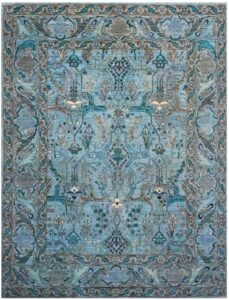
Matching rugs
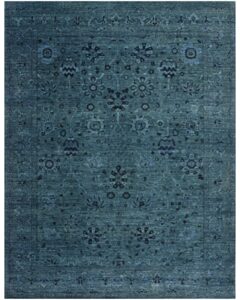
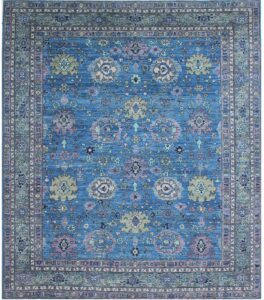
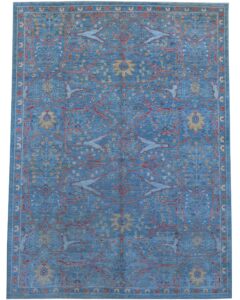
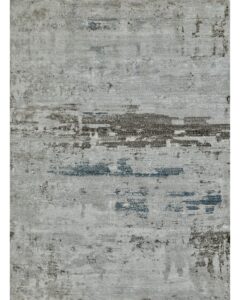
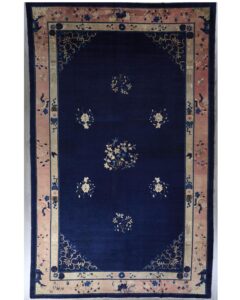
These rugs reflect the cool blues, soft greys, and grounded tones the guide suggests for rooms with yellow walls.


How Does the Shade of Yellow Change the Best Rug Color?
The shade of yellow determines the best rug color through two traits: undertone and depth. Pale cream-based yellows accept almost any mid-tone or dark rug. Saturated golds and mustards need a cool counterweight or a muted earth tone. Lemon and citron yellows with a green undertone pair with grey, navy, and ivory, and they fight rust and orange.
Undertone matters more than brightness. Hold a paint chip against plain white printer paper and the hidden base shows itself. A pinkish or peach cast signals an orange-based yellow. A faint acid tint signals a green-based one. The table below matches rug colors, weaves, and colors to avoid with each family. The LRV figures are approximate, so confirm the number printed on your own paint chip.
| Yellow Wall Family | Typical LRV (approx.) | Undertone | Best Rug Colors | Weaves That Fit | Colors to Avoid |
|---|---|---|---|---|---|
| Butter / Cream Yellow | 75-85 | Warm, neutral | Mid-blue, taupe, sage, ivory with blue accents | Oushak, Tabriz, Nain | Pale yellow, light beige |
| Gold / Mustard / Ochre | 40-60 | Orange-based | Navy, charcoal, deep teal, undyed ivory | Beni Ourain, Azilal, Bakhtiari | Matching gold, bright red |
| Lemon / Citron | 65-80 | Green-based | Slate grey, indigo, cool ivory | Modern wool flatweave, Nepalese Tibetan | Terracotta, orange, brown-red |
| Sunflower / Marigold | 50-65 | Warm, saturated | Rust-and-navy pattern, dark brown, charcoal | Heriz, Gabbeh, Kilim | Pastels of any kind |
Which Rug Suits Pale Butter or Cream Yellow Walls?
Pale butter or cream-yellow walls pair best with a mid-blue, taupe, or sage rug. An ivory-ground rug with blue and rust accents also works. The wall stays quiet enough to let the floor hold the pattern. Soft yellows are the easiest to furnish.
An Oushak with a cream field and dusty blue vine border brings three or four coordinated colors that the wall simply frames. A Tabriz with a slate and brick medallion does the same. Fine knotting shows the pattern crisply, which matters when the wall offers none. Most pieces I recommend here come from Classic & Traditional Rugs, where formal borders give an open yellow wall a structured counterpoint. Pale yellow and light beige rugs vanish into the paint and should stay off the shortlist.
What Rug Belongs Under Mustard or Ochre Walls?
A charcoal, navy, deep teal, or natural undyed ivory rug belongs under mustard or ochre walls. A matching gold never works. A strong wall color needs a floor that either retreats or contrasts firmly.
Mustard rooms are where I place the most high-pile wool from the Middle Atlas. The lanolin-rich cream wool of a Beni Ourain, with a 25 to 40 mm pile and a sparse charcoal lattice, reads as a cool neutral against ochre. An Azilal with scattered teal and magenta threads adds more color. Both belong to the family of Moroccan Rugs that handle daily foot traffic well. Long pile shows footprints, so vacuum weekly with the beater bar switched off. Bright red fails here because it competes with the orange base of the paint.
How Do You Test Reflected Light From Yellow Walls Before Buying a Rug?
A reflected-light test shows how yellow walls will tint a rug before you buy it. Lay a sample at least 12 inches square on the floor beside the wall. Photograph it at 9 a.m., noon, and 7 p.m. Compare each photo with the sample’s color in a room without yellow nearby. The difference is the cast your wall throws onto the floor.
Yellow walls bounce warm light onto nearby surfaces, so cream and pale blue pile drift toward apricot and green. Dark fields shift far less. Use a simple decision rule: if the rug’s field is lighter than your sofa, expect a visible cast and choose a navy, charcoal, or slate ground instead. Window direction also matters. North-facing rooms receive cooler daylight, so the same yellow looks duller and tolerates warmer rugs. South- and west-facing rooms intensify the yellow and favor cooler rugs.
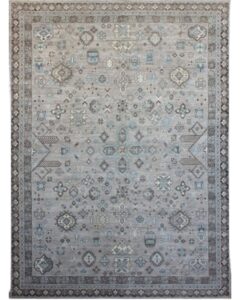
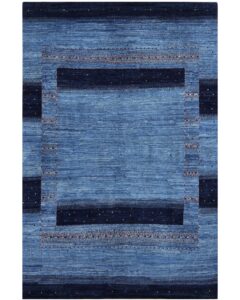
More matching rugs
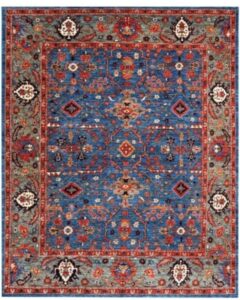
Another set of rugs that follow the same colors and style as this guide.

Which Rug Colors Work Best in a Yellow Living Room?
A yellow living room works best with a rug that is the darkest large surface in the space. Navy, charcoal, slate, and rust-and-navy traditional patterns all qualify. Size the rug so the front legs of every seat rest on it. The darker floor pulls the seating group together and keeps a sunny room from feeling floorless.
Living rooms add two variables: window treatments and upholstery. Yellow drapes make the rug work twice as hard, and my guide on what color rug goes with yellow curtains applies directly. A grey or navy sofa gives you more freedom, since the sofa already supplies the cool anchor. The rug can then bring in rust, ivory, or a softer blue.
- Standard rug size: 8 by 10 feet for a sofa-and-two-chairs layout
- Large room rug size: 9 by 12 feet when the room exceeds 15 by 18 feet
- Bare floor border: 12 to 18 inches between rug edge and wall, giving the paint a visible break
- Seat overlap: the front third of every seat rests on the rug
- Tie-in color: the rug’s darkest tone repeats in a lamp base or picture frame
How Do You Size and Position a Rug Under Yellow Walls?
A living room rug should extend 6 to 12 inches beyond the sofa on each side. Center it on the main seating group, not on the room. The bright wall color then frames the arrangement instead of exposing it. A small rug floating in the middle makes the walls feel taller and the furniture smaller.
Felt-and-rubber pads about a quarter inch thick go under every rug I install in a sunny room. The pad stops creep on hardwood, absorbs the impact that wears the foundation, and lifts the pile so color reads richer against a reflective wall. Our Rug Padding service cuts pads to exact rug dimensions, which matters when you want a precise floor border.
Dye lots, pile direction, and wall-thrown color can only be judged in place. For that reason we offer the option to Try Rugs at Home before you commit.
Do Patterned or Solid Rugs Look Better With Yellow Walls?
Patterned rugs with at least three colors usually look better with yellow walls. A flat solid under a strong wall color creates a two-tone box. A pattern with a dark ground and lighter accents gives the eye several resting places. Kilim and Heriz designs, with their bold geometry, hold their own against saturated paint.
Textured solids can still succeed. A hand-loomed charcoal wool with a 12 mm loop pile supplies enough surface variation to avoid the boxed look. So does a tone-on-tone abstract in slate and graphite. The Contemporary & Modern Rugs category carries these textured solids beside loose geometric designs that pair well with saturated paint. A pale solid is the commonest mistake I see, because it disappears into the wall’s glow.
Which Rug Materials and Dyes Hold Color Beside Yellow Walls?
Hand-knotted wool with natural or chrome dyes holds color best beside yellow walls. Yellow rooms are usually the sunniest rooms in a house. Ultraviolet light fades aniline-dyed, viscose, and polypropylene rugs, often visibly within an estimated 2 to 3 years of direct sun.
Wool fiber has a scale structure and lanolin content that slow dye loss. A good chrome dye bath bonds color into the fiber rather than coating it. Viscose, sold as art silk or bamboo silk, loses color and sheen under daily sun. Its pile mats permanently when wet, so I most often decline to wash it. South- and west-facing yellow rooms call for wool, rotated 180 degrees every six months to even out the exposure.
Why Do Natural-Dyed Wool Rugs Age Well Next to Yellow Paint?
Natural-dyed wool rugs age well next to yellow paint because indigo, madder, and walnut husk fade evenly. They soften in tone rather than shifting hue. A navy field becomes a gentle denim instead of a purple-grey. Cheap synthetic dyes lack this grace and tend to bleach in streaks.
Slow softening explains why old pieces look comfortable in bright rooms. Abrash, the subtle striping where one dye lot ended and the next began, breaks up the field. It keeps a large rug from looking like a painted rectangle. Many pieces in our Antique & Vintage Rugs collection have already faded for 60 to 100 years and will not change meaningfully in your lifetime.
How Do You Keep Rug Color True in a Bright Yellow Room?
Rug color stays true in a bright yellow room with five habits: vacuuming weekly without a beater bar, rotating twice a year, fitting UV-filtering window film, washing professionally every 3 to 5 years, and avoiding high-alkaline cleaners. Quality window film blocks up to 99 percent of ultraviolet light.
Dirt is the quiet enemy. Fine grit settles into the pile, dulls the surface, and makes a navy rug read as grey against a bright wall long before dye loss begins. A proper immersion wash with pH-balanced solution and controlled drying restores the contrast. Our Rug Cleaning process is built around that full-submersion method.
Home shampooers and store-bought spot cleaners start most of the color damage I repair. High-alkaline detergents strip dye from wool and leave pale halos. For upkeep between professional washes, follow the fiber-specific steps in my guide on how to wash rug instead of renting a machine.
My Experience Matching Rugs to Yellow Walls
My Boulder project with Hawthorne Yellow-style walls settled my thinking about rug color. The living room had a warm gold close to Benjamin Moore’s Hawthorne Yellow and two south-facing windows. The client had just bought a pale cream Oushak online. On the showroom floor the rug was lovely. In the room, the gold walls threw so much warm light onto the cream pile that the whole rug turned a sickly apricot by early afternoon, and the blue vines in the border disappeared.
We swapped it for a 9 by 12 foot Heriz with a rust medallion on a navy field, roughly 110 years old, that I had washed the previous spring. The dark ground absorbed the glare, the rust sat comfortably against the gold, and the navy made the yellow read as deliberate instead of accidental. The client later told me friends assumed they had repainted. They had not touched the walls.
Which Rug Pairings Have Failed on Yellow Walls?
Pale yellow or beige rugs, bright red rugs, and viscose rugs in any color fail most often on yellow walls. Pale rugs vanish into the floor. Bright red turns the room into a condiment palette. Viscose fades unevenly within two summers of south-facing sun.
One Denver dining room still bothers me: lemon-yellow walls and a brand-new polypropylene rug in bright tomato red. The client insisted it would warm the room. Within eighteen months the red had bleached in a sharp line where the window light fell, and the unfaded portion under the table looked almost fluorescent beside it. Polypropylene cannot be re-dyed, so I had nothing to restore. A natural-dyed wool piece would have softened into something gentler, and a navy one would never have fought the walls at all.
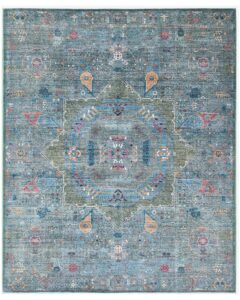
Final picks
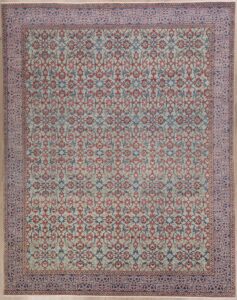
One last row of rugs chosen to go with the ideas above.
FAQ: Rug Colors for Yellow Walls
Homeowners standing in a freshly painted yellow room with a bare floor ask me the same five questions.
Each short answer below reflects pairings I have tested on client floors.
Which rug color goes with yellow walls and a grey sofa?
The right rug for yellow walls and a grey sofa carries warmth and pattern, such as a rust-and-ivory Heriz, a terracotta Gabbeh, or an ivory Oushak with blue and apricot accents. The sofa already supplies the cool anchor.
Plain grey rugs fall flat here. Grey on grey under yellow walls leaves a dull lower half and a glowing upper half.
Can a terracotta rug go in a yellow living room?
Terracotta rugs suit a yellow living room when the paint is warm gold, butter, or ochre, since all three share an orange base. Add a navy or dark brown accent to keep the palette from overheating.
Lemon or citron yellow with a green cast changes the verdict. Against that wall, terracotta looks muddy.
Which rug color makes a yellow room look bigger?
A mid-tone rug with an LRV near 30 to 45, such as denim blue, warm grey, or oatmeal, makes a yellow room look bigger. It avoids a hard dark block at the center of the floor.
Leave at least 12 inches of exposed floor around the perimeter. In rooms under about 12 by 14 feet, choose a mid-tone over very dark rugs.
Will a rug fade faster beside yellow walls than white ones?
Paint color does not fade a rug, so yellow walls cause no extra fading. Direct ultraviolet light breaks down dye, and yellow rooms are often chosen for their sun.
Wool with chrome or natural dyes softens gently over years, while viscose or polypropylene can fade visibly in 2 to 3 years. Window film, rotation, and washing protect the color.
Should a rug match yellow walls or contrast with them?
Contrast works better than matching. A yellow rug under yellow walls removes every visual boundary and makes furniture appear to float.
Choose a darker, cooler rug with at most a thin gold line echoing the paint. If you want yellow underfoot, limit it to a mustard stripe in a kilim and keep the field navy, charcoal, or ivory.
Sources for Yellow Wall and Rug Color Pairing
Wikipedia: Complementary Colors
Wikipedia: Natural Dye
